Tatami chairs on heated floors: moisture and fit
Low chairs standing over underfloor heating live in a drier, warmer microclimate than the room around them, and they fail as open joints and rattling frames rather than as a broken part. The fix is decided at the kiln and on the drawing, not at installation.
Published by JPChairs · Chair manufacturer in Foshan, China · 2026-11-16
The microclimate 150 mm off the floor
The screed runs at 35 to 45 C to hold the floor surface at 27 to 29 C, and a 300 mm seat sits about 150 mm above it, where the air runs 2 to 4 C warmer than at head height. That is enough to move the moisture equilibrium of the whole frame.
- Timber at 22 C and 50% RH settles near 9 to 10% moisture content; over a heated floor at 32 C and 40% RH the same timber settles at 6 to 7%.
- Tangential shrinkage runs 0.25 to 0.30% of width per point of moisture content, so a 400 mm glued seat that dries from 10 to 7% pulls in 3.0 to 3.6 mm across the grain.
- Each 28 mm square leg loses 0.5 to 0.7 mm of section, which is exactly the amount that opens a shoulder line on a tenon fitted tight at the bench.
- Chairs packed at 11 to 12% in a humid month and installed over heating in November can drop 5 points in six weeks, twice the seasonal swing the joint was drawn for.
Glue lines that creep instead of failing
Nothing snaps. Adhesive joints over a warm floor fail by slow slip, and by the time a guest feels the wobble the tenon has polished its own mortise.
- Standard PVAc assembly glue softens at 60 to 70 C but creeps at 35 C under sustained load; a joint carrying 120 kg of guest weight can show 0.3 to 0.5 mm of slip over two years.
- One-component PUR keeps about 80% of its strength at 60 C and does not creep at floor-heating temperatures, which is why every knock-down low chair we ship for heated rooms is glued with PUR.
- Neoprene contact adhesive softens first under laminate; a 40 mm edge strip lifts in 12 to 18 months at 35 C where a reactive PUR adhesive holds.
- Nitrocellulose lacquer gives up 2 to 3 pencil hardness points at 35 C and prints under a heel, while two-component PU lacquer or a hardwax oil with 2% carnauba keeps its film.
Drawing the movement into the joint
Every wide part needs somewhere to go, and the cheapest place is a slot somebody drew on purpose.
- Seat panel grooves get 2.0 to 3.0 mm of clearance, with the panel free on three edges and pinned at one only.
- Knock-down bolt holes on rails become 3 mm slots each side of nominal, so a 400 mm panel moving 2 mm never loads the bolt in shear.
- Frame shoulders are cut with a 0.2 to 0.3 mm gap rather than a dead fit; a visible hairline costs less than a split stile.
- Woven seats get 1.0 to 1.5 mm of seasonal allowance at each rail, because a cane or paper-cord seat tensioned wet will drum once the heating season starts.
Feet on a warm screed
The foot is where a light chair becomes a point load, and heating changes what the pad under it can take.
- An 80 kg guest plus a 12 kg chair puts 60 to 65% of the load on the rear feet, about 600 N per pair, and a 30 mm pad spreads each foot to roughly 880 kPa.
- Felt compresses 25 to 35% in the first two years at 35 C and stops protecting the floor; a PP core with a 3 mm felt face holds its thickness and still slides quietly.
- PVC pads soften above 40 C, and their plasticiser migrates into pale screed and vinyl flooring as a brown ring that no cleaner removes.
- EPDM is rated to 100 C and silicone to 200 C, so both are safe over heating, but silicone leaves a grey smear on light floors under load.
The 21-day heat soak before packing
We stopped trusting room-condition meter readings on heated-floor orders and put the batch in a warm room instead.
- Three chairs per batch sit 21 days at 32 C and 40% RH, which is roughly the first winter in a heated tea room compressed into three weeks.
- Pin meter readings at six points per chair must land at 7 to 9% at packing; anything above 10% is re-stickered and held rather than shipped.
- Seat width, panel gaps and leg squareness are measured before and after at 0.5 mm resolution, and a change over 1.5 mm on any of them fails the batch.
- The soaked chairs then take the standard 1,600 N seat and 300 N backrest loads at 32 C, because a joint that only holds when cold is not a joint.
- The last 7-day cycle at 35 C and 30% RH catches over-dried stock, which cracks at the end grain before it ever reaches a customer.
What goes on the purchase order
Heated-floor performance is invisible on a sample chair, so it has to be written down line by line.
- Moisture content 7 to 9% at packing, with the kiln schedule stated on the inspection report.
- PUR adhesive on every knock-down joint, and no PVAc substitution without written approval.
- Slots rather than holes on all cross rails at 3 mm each side, plus 2.5 mm panel gaps.
- One service temperature line on the label: suitable for floor heating up to 35 C surface.
- 10% spare glides in the carton, since pads are the part that wears first over a warm floor.
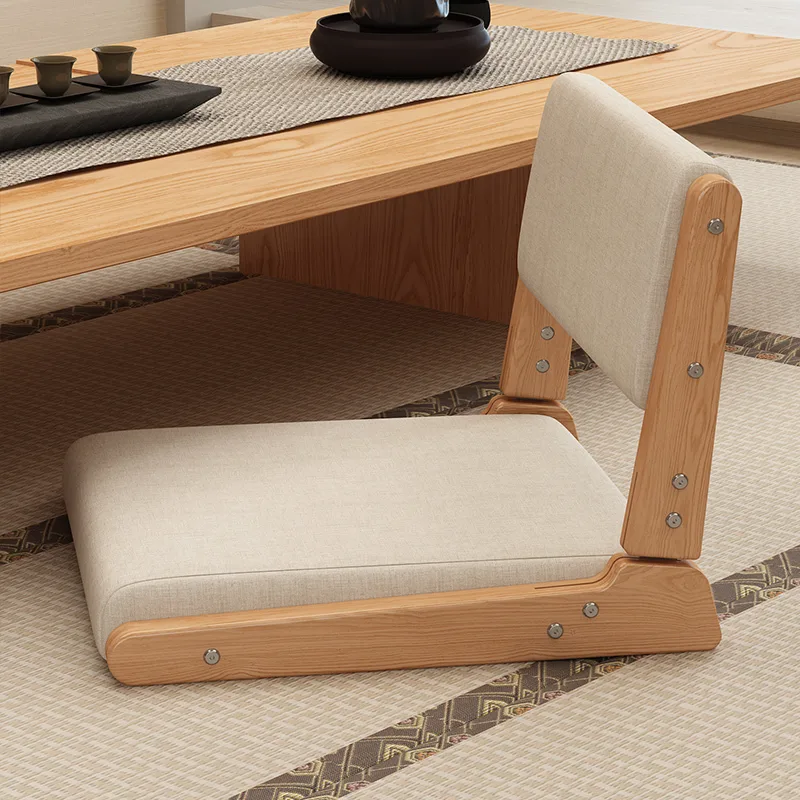
The chairs built to this sheet are the low tatami chairs for heated tea rooms in the catalogue, and the moisture limits travel with each order as OEM moisture content specifications.