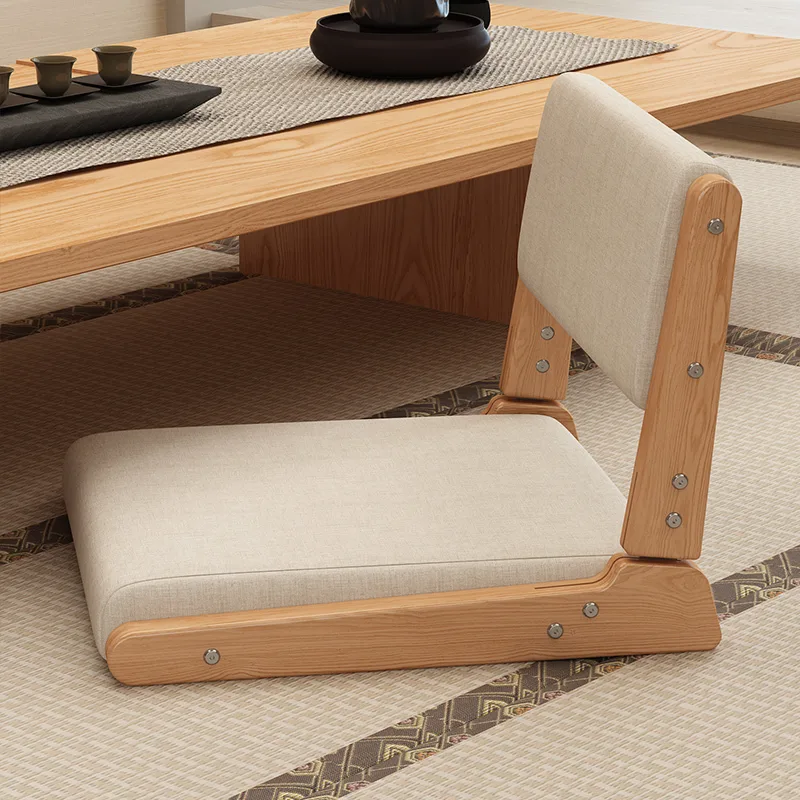
Getting out of a 350 mm tatami chair: the armrest heights, frame weights and clearances that make low seating usable for older guests
Low seating looks restful and reads badly on the one movement every guest makes several times a meal: standing up. A 350 mm tatami seat is not a small step down from a 450 mm dining chair, it is a different task, and guests over 65 notice it on the first visit. This is the arithmetic behind that, and the armrest geometry, frame weight and clearances that make a low chair leaveable.
Published by JPChairs · Chair manufacturer in Foshan, China · 2026-11-01
What standing up from a 350 mm seat actually costs
Take a 1.70 m adult weighing 80 kg. Seated on a 450 mm dining chair the body's centre of mass sits near 720 mm above the floor; standing, it is near 950 mm. That is a 230 mm lift, and at 80 kg it is about 180 joules of work against gravity every time the guest gets up. Drop the seat to 350 mm and the seated centre of mass falls to roughly 630 mm, so the lift becomes 320 mm and the work about 250 joules, close to 40 per cent more. At a 300 mm floor-level seat it is 370 mm and roughly 290 joules, about 60 per cent more than the dining chair.
Joint load rises faster than the work does. Peak knee extension moment goes from roughly 1.0 Nm per kg of body weight off a 450 mm seat to about 1.4 Nm/kg off 350 mm, and near 1.7 Nm/kg from the floor. For an 80 kg guest that is 112 Nm against 80 Nm. Anyone with a stiff knee, a replaced hip or simply less quadriceps than they used to have reads that difference as a decision, and they choose a different table next time.
Armrest heights that carry load
A decorative armrest is worse than none at all, because guests trust it and it folds. Three numbers decide whether it helps:
- Height above the seat front edge: 180 to 210 mm. On a 350 mm seat that puts the top at 530 to 560 mm from the floor. Below 170 mm the guest cannot get an elbow under themselves; above 230 mm the shoulders shrug and the push goes sideways.
- Usable grip length: 150 mm minimum at the front, 35 to 45 mm wide, with a 25 mm clear gap between the armrest and the seat edge so fingers wrap rather than pinch.
- Forward projection: 60 to 90 mm past the seat front edge. The hands have to land ahead of the hips, or the push drives the guest backwards into the chair instead of up out of it.
We load armrests at the front 100 mm: 750 N vertical and 400 N horizontal, deflection under 8 mm and residual under 2 mm, then 25,000 push-off cycles at 0.5 Hz. The usual failure is not the armrest itself but two M8 bolts threaded into a 1.5 mm wall tube; a 2.0 mm wall or a welded gusset takes the cycle count from about 6,000 to past 30,000.
Frame weight and the backwards tip
Push-off through one armrest peaks at about 0.35 of body weight, so 280 N for an 80 kg guest, applied horizontally at 550 mm above the floor. That is a large overturning number for a light frame, and we tip-test to the point where the rear legs lift:
- 4.0 kg aluminium low chair, rear leg 40 mm behind the seat: tips at about 180 N.
- 6.5 kg frame, rear leg extended 80 mm past the armrest front: about 320 N.
- 6.5 kg frame, 120 mm rearward foot and a 5 degree rearward leg rake: about 410 N.
Specify 6 kg minimum for any low chair with armrests, and buy the stability with rear leg extension rather than with ballast. Weight bolted into the seat pan raises the centre of mass and makes the tip worse per kilogram added, while 80 mm of rear footprint costs almost nothing and moves the threshold by roughly 40 per cent.
Heel tuck, seat depth and the front edge
The cheap fixes are in the clearances, and they are the ones most often left off the drawing:
- Under-seat clearance: 120 mm minimum between the floor and the underside of the seat front rail, so the heels can slide back 150 to 200 mm before the guest commits to standing. Tucking the heels back takes roughly 15 to 20 per cent off peak knee moment.
- Seat depth: 400 to 450 mm, front edge to backrest, with the front 60 to 80 mm of the pan sloping down 3 to 5 degrees so the thigh is not loaded behind the knee.
- Front edge radius: 8 to 12 mm. A sharp edge at 350 mm is felt through the calf every time the guest turns to leave.
- Backrest angle: 100 to 108 degrees from the seat pan. More reclined than that and the guest starts the movement from behind their own hips.
What to specify, and the test to run
- Armrest top height measured from the floor, not from the seat, with a 5 mm tolerance: 530 to 560 mm on a 350 mm seat.
- Load lines: 750 N vertical, 400 N horizontal, deflection under 8 mm, residual under 2 mm, 25,000 push-off cycles.
- Frame mass floor of 6 kg, and rear leg extension of 80 mm past the armrest front.
- Under-seat clearance of 120 mm and 150 mm of heel tuck.
- Acceptance test: five users from 60 to 95 kg stand five times each, under 3 seconds per rise, with no rear leg lift and no chair travel over 30 mm.
That last line catches the problems, because it runs on the floor the chairs will actually sit on rather than on a concrete slab. Every figure above is measured on the frames we build as armrest tatami chairs, and the push-off load test is part of the armrest inspection workflow that runs before packing.