Seat pan rake and backrest recline on low seating: the two angles that decide whether a floor-level chair is comfortable or just low
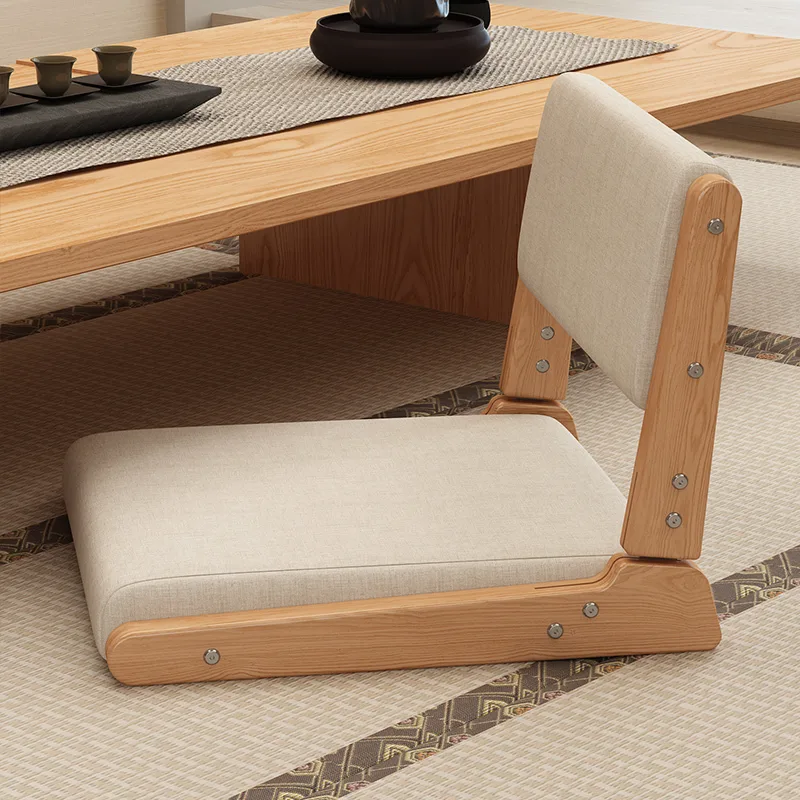
A low chair is unforgiving about angle. At a 450 mm seat a guest can shift, cross a leg and carry on; at 300 mm there is nowhere to move to, so the two angles in the frame - how far the seat pan tilts back and how far the backrest leans - do all the work. This is what we set in the jig and what we measure before a frame goes to finishing.
Published by JPChairs · Chair manufacturer in Foshan, China · 2026-11-03
The two angles, and why low seating narrows the range
Two angles decide the posture. Seat pan rake is how far the sitting surface tilts back from front to back, read off the floor plane. Backrest recline is how far the back leans from vertical. Together they set the included angle between seat and back, and that is the number a guest actually feels.
- Seat pan rake: 3 to 5 degrees on a 380 to 450 mm seat, 5 to 7 degrees below 350 mm. The lower the seat, the more rake it needs to stop the pelvis sliding forward.
- Backrest recline: 8 to 12 degrees from vertical for dining at a 320 to 360 mm table, 18 to 25 degrees for a lounge chair used away from a table.
- Included angle: 95 to 100 degrees upright, 105 to 110 degrees relaxed. Below 92 degrees the diner is folded over the table; past 112 degrees they need a footrest, which a tatami room rarely has.
The range is narrower than on a normal chair because the hips and knees are already near their limit: at a 300 mm seat the knee sits at 95 to 100 degrees and the hip at 60 to 65. Another 5 degrees of recline without a matching change in rake pushes the hip past 70, and the guest starts bracing with the feet.
Lumbar height and backrest height by seat height
Recline only helps if the backrest touches the right place. The crest of the lumbar support should sit 120 to 180 mm above the compressed seat surface, and the top edge of the backrest 300 to 400 mm above it on an upright low chair, 450 to 500 mm on a lounge version.
On a 350 mm seat that puts the lumbar crest at 470 to 530 mm from the floor and the backrest top at 650 to 750 mm, low enough to pass under a 700 mm window sill. We check contact with 100 N applied 300 mm above the seat for 30 seconds: the gap behind the lumbar has to close to 25 mm or less, otherwise the recline is decorative.
Backrest width matters just as much. Below 380 mm the shoulder blades sit over the posts instead of the panel and guests call the back narrow even when the angle is right; above 480 mm the back reads as a sofa back and takes over a small room.
What rake does to pressure and to the floor
Rake is not cosmetic. Moving a seat pan from 0 to 5 degrees shifts the centre of pressure 15 to 20 mm rearward on a 400 mm deep seat. On a pressure mat the peak reading under the ischial tuberosities falls from about 8.5 to 6.8 kPa on a 70 kg sitter, and thigh contact rises from roughly 60 to 72 per cent of the seat depth.
The same change moves load onto the frame. Sitting upright, the front and rear legs carry about 55 and 45 per cent of body weight; at 20 degrees of recline that becomes 40 and 60. On a tatami mat that rearward shift is what turns an acceptable glide into a denting one, so recline and glide diameter have to be specified together - the contact figures on our tatami chairs built to measured seat rake are quoted with the recline they were taken at.
Holding the angles in the jig
- Jig wedge: the seat rail sits on a machined wedge, not on a packer. Two degrees on a 400 mm seat is a 14 mm packer, and packers move.
- Tolerance: plus or minus 1 degree on each angle, read with a digital protractor to 0.2 degrees.
- Post symmetry: the two back posts within 0.5 degrees of each other, which is 3.5 mm over a 400 mm post. A back 0.5 degrees out of square twists the sitter's shoulders and is the most common reason a sample comes back not right with no other fault.
- Fastening: M8 bolts at 12 to 15 Nm on the back-to-seat joint, plus a second torque pass 24 hours later. Under-torqued posts lose 1 to 2 degrees within a month.
Both angles are set on the first frame off the jig and re-checked on every twentieth. Changing rake after sample approval costs a new wedge at USD 120 to 180, 2 days of tooling and 20 to 30 frames of rework at USD 8 to 14 each.
Creep, humidity and how the angle drifts
A backrest does not stay where it is put. Over the EN 16139 L1 duty cycle we build frames to - 200,000 seat cycles at 120 kg - a bolted back joint settles 0.8 to 1.5 degrees rearward, most of it in the first 20,000 cycles as the tenon shoulders and bolt faces bed in. We pre-set the back 1 degree forward of nominal so a chair lands inside tolerance at the end of its life.
Wood moves it too. A seat rail leaving at 10 per cent moisture content and settling at 12 per cent in a tatami room held at 55 to 65 per cent RH swells 0.1 to 0.2 mm across a mortise shoulder, worth about 0.3 degrees of backrest change. That is inside tolerance on its own, but it is why we condition frames for 7 days at 20 C and 55 per cent RH before the final angle check, and why the check is done on a frame from the middle of the batch rather than the first one made.
Upholstery adds the last term. A 30 mm foam pad compressed to 22 mm under a 70 kg sitter adds about 1 degree of effective rake; a 60 mm cushion in the zabuton style adds 2 to 3. Specify cushion and frame together, or the finished chair sits 3 degrees further back than the drawing.
What to write into the order, and how to check it
- Seat pan rake in degrees with the seat height it applies to: 5 degrees at 350 mm, 4 degrees at 400 mm.
- Backrest recline from vertical plus the included angle you actually want: 100 degrees for dining, 108 degrees for lounge.
- Lumbar crest 120 to 180 mm above the compressed seat; backrest top 300 to 400 mm above it.
- Tolerances: plus or minus 1 degree per angle, posts within 0.5 degrees, verified after 7 days of conditioning.
- Acceptance: a 30-minute sit trial with five users and a pressure mat reading with the ischial peak under 7 kPa.
- Drawing note: back pre-set 1 degree forward of nominal to absorb creep.
Put the angles on the drawing as numbers rather than a rendered view, and re-check them against our OEM backrest angle drawings before the sample is approved.