How much contact pressure a tatami mat takes before it dents, and the glide sizes that stay under it
Tatami mats are 55 mm of compressed rice straw under a woven igusa skin with no coating. Anything that presses a crease into that skin keeps the crease, which is why a chair that sits happily on stone for ten years will mark a mat in one evening. The variable is not weight, it is contact pressure.
Published by JPChairs · Chair manufacturer in Foshan, China · 2026-10-30
What a tatami mat is built from
Three layers, and none of them behaves like a timber floor:
- Dimensions: a full mat is 880 by 1,760 mm and 55 mm thick, weighing 24 to 30 kg; a half mat is 880 by 880 mm. Rooms are planned in whole mats, so furniture has to fit those modules.
- Core: compressed rice straw at 180 to 220 kg/m³, or in newer mats a 15 to 30 mm extruded polystyrene board at 20 to 30 kg/m³ behind a thin straw facing.
- Skin: igusa rush woven at 1.2 to 1.5 mm per strand over a weft, with a 6 to 10 mm cloth border binding the long edges.
- Finish: none. No lacquer, no wax. The skin takes up a spill in 30 to 60 seconds and dries over 6 to 12 hours.
Two things follow. The surface yields under anything narrow, and it holds water long enough for a pressed crease to set. Both are problems for the chair, not the mat.
Contact pressure: the arithmetic that decides it
Pressure equals load divided by contact area, and across four legs the area is small enough that the answer lands in megapascals. Take an 80 kg guest on a 6 kg chair, so 86 kg or 844 N:
- 20 mm glide: an effective contact ring of about 12 mm gives 113 mm² each and 452 mm² total, so 1.87 N/mm², roughly 1,870 kPa.
- 40 mm felt pad: 1,257 mm² each and 5,027 mm² total, so 0.17 N/mm², about 168 kPa.
- Two 60 by 400 mm base rails: 48,000 mm² of contact, about 18 kPa.
- Kneeling guest: both shins over roughly 60,000 mm², about 14 kPa.
That last line is the benchmark worth keeping. Traditional tatami use never exceeds about 15 kPa, so we hold chair contact pressure at or below 150 kPa under the rated seat load. That is ten times the traditional figure, which a mat tolerates for a seated evening and not for a twelve-hour function.
Glide diameter and material: what we fit
- 40 mm wool felt, 3 to 4 mm thick: about 168 kPa at 86 kg. Service life 12 to 18 months in a ryokan, replaced once 2 mm of felt remains.
- 30 mm felt: about 298 kPa, and a visible ring after a single three-hour function.
- 25 mm PTFE slider: about 430 kPa. Correct for sliding an empty chair, wrong for a seated load; use a 40 mm PTFE-faced disc if a chair has to move while occupied.
- Nylon and polypropylene glides: not used on tatami. The hard rim cuts igusa strands instead of pressing them.
- Casters: excluded from tatami-room models entirely. A 50 mm caster spreads to about 107 kPa statically, which is acceptable; the damage is cumulative, because 200 passes along one path roll the same strands flat into a 1.5 to 2 mm channel.
Fixing matters as much as diameter. A 5 mm barbed stem needs a tube wall of 1.2 mm or more, and glued caps pull out within three to four months of daily repositioning.
Humidity is the second half of the problem
Igusa and straw both move with moisture, so the identical load behaves differently in July and in January:
- 55 to 65 per cent RH: the band mats are made and installed in. Dent depth is at its lowest and recovery runs close to 60 per cent.
- 70 per cent RH and above: dent depth roughly doubles, and 24-hour recovery falls from about 60 per cent to 30 per cent.
- 30 to 40 per cent RH: a heated winter room. The skin goes brittle and cracks along an existing dent rather than recovering.
- New mats: allow 14 days before heavy use; they settle 2 to 4 mm across the width in the first month.
In practice: hold the room between 50 and 60 per cent RH, run dehumidification through July and August, and lift low seating off the mat for at least one day a week so compressed straw can rebound.
The 24-hour indentation test we run
We test the glide rather than argue about it, on a mat offcut rather than on a guess:
- Sample: a 300 by 300 mm mat offcut, conditioned 48 hours at 23 °C and 55 per cent RH.
- Load: 1.5 times the rated seat load, so 180 kg for a 120 kg chair, applied through the production glide set for 24 hours.
- Measurement: dial gauge at 0.01 mm resolution, five points under the contact patches, deepest reading counts.
- Pass: 1.5 mm or less immediately after unloading, and 60 per cent recovery or better after 24 hours at rest, so a 1.5 mm dent has to come back to 0.6 mm.
Two real results from the same mat. A 20 mm glide left 3.2 mm and recovered to 2.4 mm, which is 25 per cent recovery and a fail. Wool felt at 40 mm left 0.9 mm and recovered to 0.3 mm, or 67 per cent, which passes with margin. We run a second sample at 70 per cent RH to get the wet figure before any glide is signed off.
What to put on the drawing
- Contact pressure at or below 150 kPa at the rated seat load, written as a number.
- Glide contact diameter of 40 mm minimum, 3 to 4 mm wool felt, barbed 5 mm stem.
- No casters, and no bare metal anywhere below the frame.
- Full-width base rail wherever the frame geometry allows one.
- Spare glides at 4 per cent of order quantity, shipped loose, with a 12 to 18 month replacement cycle in the maintenance sheet.
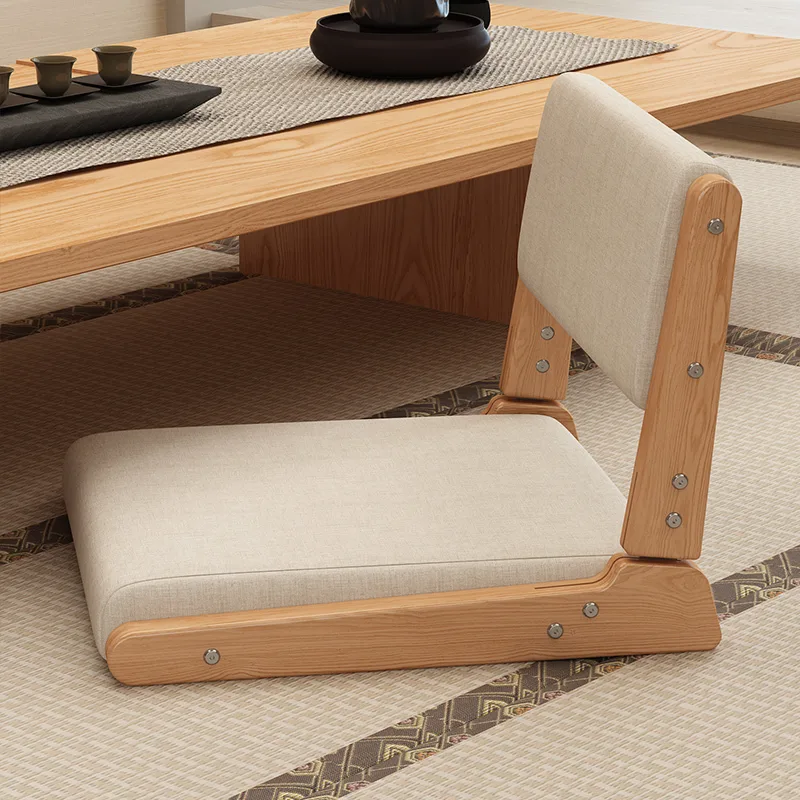
Glide diameter, felt density and stem size are frozen during the OEM glide specifications stage, because changing them after the frame is tooled usually means a new leg. The frames built to this pressure limit sit with our low tatami chairs.