How tatami chair legs spread the load
A low chair does most of its damage where it touches the floor. Legs, rails and splay angles decide whether a 90 kg guest leaves a flat tatami mat or a permanent dent, so the load path is the first thing we draw, not the last.
Published by JPChairs · Chair manufacturer in Foshan, China · 2026-11-05
Why the load path comes first
A seated guest is a moving point load. On a 350 mm high floor chair, a 90 kg guest delivers about 720 N through the frame, and where that force reaches the floor decides whether the tatami weave recovers or takes a permanent set. Padding cannot fix a bad load path: foam spreads pressure across the guest, not across the floor. So we draw legs and rails first, then build the cushion around what the frame already spreads.
- Four small feet: the whole guest weight lands on roughly 6 to 12 square centimetres of contact.
- A legless rail base: the same load spreads over 60 to 90 square centimetres, about eight times the area.
- The lean-back factor: 60 to 65 per cent of seated load shifts onto the rear contact points, so rear feet need more area, not equal area.
Three leg families and how they spread load
We build low tatami chairs on three leg families, and each puts a different number on the floor:
- Straight four-leg: feet of 19 to 22 mm steel tube give 2.8 to 3.8 square centimetres each, which puts around 180 N per foot and pressure above 500 kPa under a 90 kg guest. Fine on tile, risky on rush tatami.
- Splayed legs at 10 to 15 degrees: splay widens the footprint by 40 to 60 mm per side and raises the lateral tipping threshold from about 140 N to 260 N, but the foot still lands on a small disc unless a pad is added.
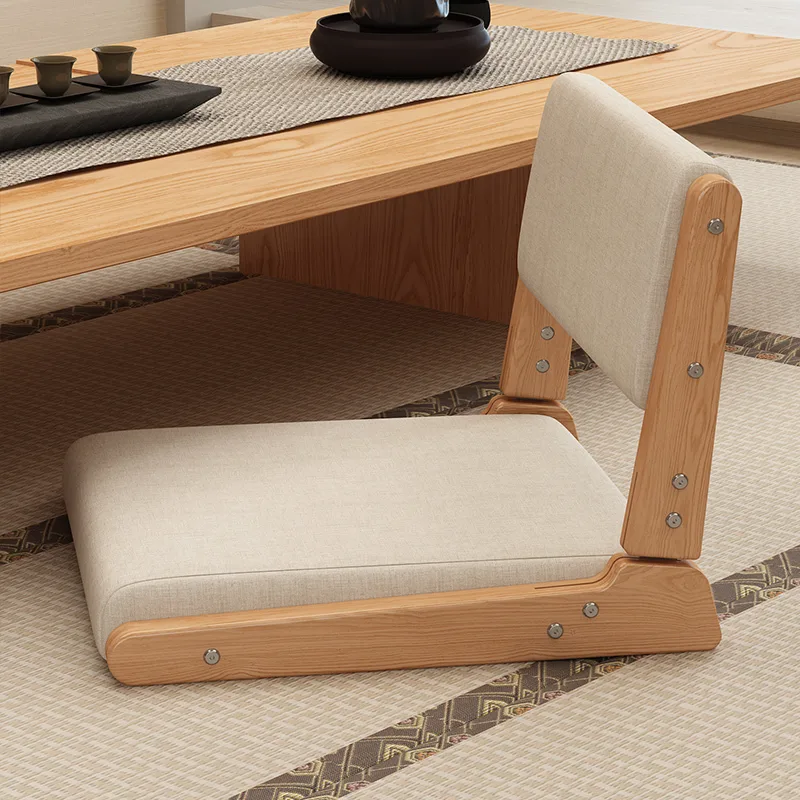
- Legless rail frame: two 45 by 30 mm rails touching through an 8 mm strip give about 80 square centimetres of contact and pressure near 9 kPa, the gentlest option for soft floors.
For rooms with mixed flooring we usually recommend the rail frame, or a four-leg frame fitted with 30 mm beech feet.
The numbers we hold on rails and joints
Rails carry the frame, so they get the tightest numbers:
- Static load: the most loaded corner takes 1,500 N for one minute, with less than 2 mm of permanent set afterwards.
- Rail stiffness: mid-span sag no more than L/250 under test load; on a 400 mm rail that is 1.6 mm.
- Joints: 8 by 40 mm dowels or M8 bolts with serrated flanges; dowel pull-out must exceed 1,200 N per joint.
- Rocking: the front rail survives 25,000 cycles at 950 N front-to-back, because low chairs get rocked, not lifted.
A front stretcher set 60 mm above the floor doubles as a kick guard and stiffens the frame against that rocking cycle.
The floor changes the specification
The same frame behaves differently depending on what it stands on:
- Tatami: the rush surface recovers from brief loads under roughly 40 to 50 kPa, but takes a permanent set above that over an hour, so we keep designed contact pressure below 30 kPa.
- Hardwood: bare 22 mm steel feet under 900 N can dent lacquer; wider feet or beech pads drop pressure below the 150 kPa mark where most finishes survive.
- Tile: splayed legs that land on a 3 mm grout line chip it, so foot positions should be checked against the joint pattern before a layout is signed off.
- Carpet: legs sink 8 to 12 mm into pile, which favours straight legs over splayed ones.
Frame details that protect the floor
Beyond the foot itself, three details decide the day-to-day outcome:
- Rear bias: we widen rear feet or extend the rear rail 80 to 100 mm beyond the seat back on four-leg frames, matching where the load actually lands.
- Bonded pads: pads glued into a recessed pocket stay put; pads slipped over the tube walk off within weeks and the bare foot takes over.
- Edge chamfer: a 2 mm chamfer on wooden feet removes the sharp edge that scars softwood flooring even at moderate loads.
These are drawing-level decisions, which is why we put them on the OEM frame drawings before a sample is cut rather than after the first floor complaint.
What we verify before packing
Every low-chair order runs three checks tied to the floor, not just the frame:
- Corner static test: 1,500 N for 60 seconds on the most loaded corner, permanent set under 2 mm.
- Bare-frame dent check: a 100 kg flat weight sits on the assembled frame, without pads, on a tatami test panel for 24 hours; the panel must spring back with no visible ring. This proves the frame on its own, separately from whatever pads a client adds later.
- Four-foot level check: against a 2 mm straightedge, all feet must touch within 0.5 mm so the frame never rocks and hammers one corner into the mat.
The same floor-first logic runs through our tatami chairs built on spread rail frames, where contact pressure is quoted per design instead of left to chance.