Tatami Chair Cushion Thickness and Compression
On a tatami chair the cushion is not a comfort accessory, it is a structural part of the seat height. A pad 10 mm thicker turns a dining-height low chair into a lounge chair, and a pad that settles 6 mm in its first year quietly changes the table clearance the room was designed around.
Published by JPChairs · Chair manufacturer in Foshan, China · 2026-11-13
The seat height budget starts at the cushion
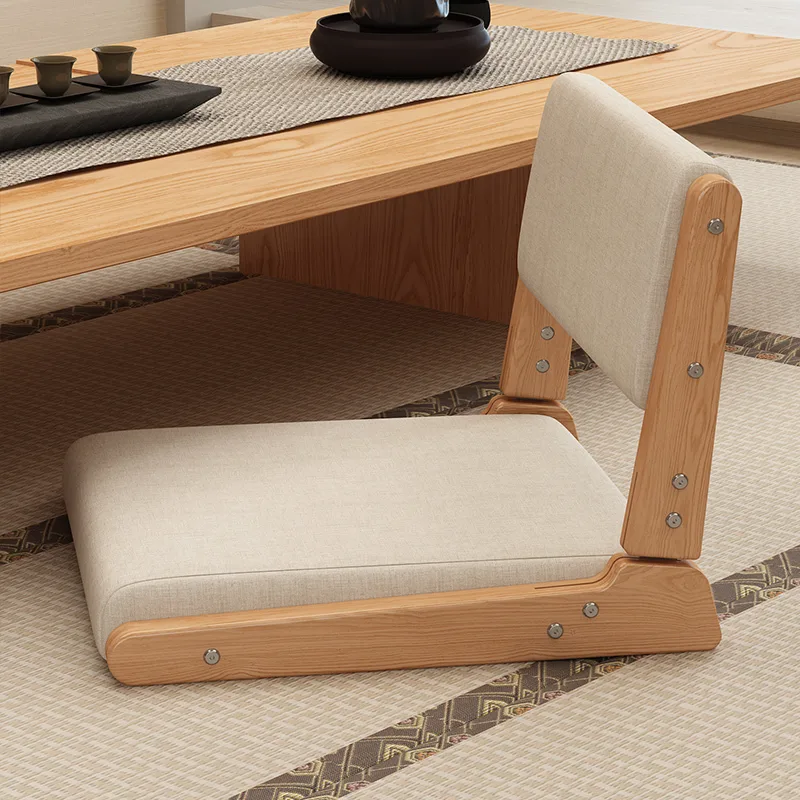
The tatami chair is specified from the finished seat down, not from the frame up. A guest at a 300 to 330 mm table in a tatami room wants a seat between 270 and 320 mm, and everything below that number is frame plus cushion.
- The 272 mm frame with a 28 mm pad gives a finished seat near 300 mm before load, and about 291 mm once an 80 kg guest is seated.
- The 20 mm pad on a 280 mm frame reads as a hard stool; a 40 mm pad on the same frame reads as a low lounge chair. The difference is judged in the first ten seconds of sitting.
- Knee clearance under the table follows the seat, so cushion thickness belongs on the table drawing as much as on the chair drawing. Every 10 mm of pad moves the knee line by the same 10 mm.
- Frame, pad and table must be quoted together. Cases where a buyer sources tables separately and then raises the pad to 45 mm are the ones that end with guests sitting with their knees against an apron.
How much a thin cushion actually compresses
Use numbers rather than impressions. An 80 kg guest puts about 785 N through a 400 by 400 mm pad, roughly 4.9 kPa averaged over the face and 9 to 14 kPa under the ischial tuberosities where the load concentrates.
- Standard 35 kg per cubic metre polyurethane at 30 mm with a 25 percent IFD of 110 N settles 8 to 11 mm under that load, which is 27 to 37 percent of its thickness.
- The same foam at 40 mm settles 10 to 13 mm because the load spreads through more material, so the seat drops by a similar amount while the peak pressure falls 15 to 20 percent.
- 45 kg per cubic metre high-resilience foam settles 6 to 8 mm at 30 mm and recovers to within 1 mm in under a minute, which is what stops a floor-level seat feeling bottomed out after a long dinner.
- Add a 12 mm ply pan and the pad has nowhere to go but sideways, so a thin pad on a rigid pan reads harder than the same foam on webbing. Tatami chairs are almost always the rigid version.
Foam grades that survive floor-level seating
Floor-level seating loads foam differently from a dining chair. The pad is thinner, the base is usually 12 mm ply with no springs, and the front edge takes the guest's shins on every entry.
- Density 30 to 45 kg per cubic metre. Below 30 the cell walls collapse at the front edge within 12 to 18 months of hotel use.
- 25 percent IFD between 90 and 130 N, with a sag factor of 2.2 to 2.6 so the foam stiffens as it compresses instead of bottoming out on the pan.
- Compression set of 5 percent or better to ASTM D3574 method D, 22 hours at 70 C. This single number predicts whether the pad is flat by month 18.
- The 10 mm needle felt or 3 mm dacron layer under the cover spreads the front edge load and adds about 0.30 USD per pad, which is the best value line on the whole bill.
- Cost of the foam itself runs 0.60 to 1.20 USD per pad across those grades, so density is not where a low chair order should be economised.
Fixing the cushion so it does not slide
The loose cushion on a low chair walks forward every time a guest pushes back to stand. After a month the front edge overhangs the frame by 15 to 20 mm and the first complaints arrive about the chair feeling unstable.
- 25 mm hook and loop tape at 3 to 5 N per centimetre of peel strength, in four strips, is the cheapest reliable answer and lets the cover come off for cleaning.
- Two 20 mm webbing straps across the pan with snap fasteners hold a 40 mm pad with no adhesive and survive more than 5,000 removal cycles in our shop test.
- Four M5 by 16 screws through brass grommets into weld nuts, at 3.5 to 4.5 Nm, is what we fit when the pad must not move at all, such as in a rental or banquet setting.
- Glue is the one method we avoid here. The cover cannot be washed, and the foam is scrapped at the first re-cover, which doubles the cost of the second year.
When a tatami cushion is finished
Service life on a low chair pad runs 24 to 36 months in a hotel with daily use and up to 48 months in a private residence. Three signs say replace rather than recover, and all three are visible in a five minute walk-through.
- Permanent settlement over 6 mm measured 30 minutes after the guest stands, against a 1.5 mm tolerance on a new pad.
- Foam that crumbles at the front edge when pressed, or a pad that has gained more than 5 percent in weight from absorbed moisture in a humid room.
- Cover abrasion past 30,000 Martindale cycles at the front roll, which is where shins contact the pad on every entry.
Each new pad costs 8 to 14 USD depending on cover, and recovering takes 4 to 6 minutes per pad once the cover is off. That is why hotel projects ship two spare covers per 50 chairs: a cover swap is a housekeeping task, a foam replacement is a workshop job.
Spec numbers to write into the order
An order sheet should carry five cushion numbers. With fewer than five, thickness and hardness drift between batches and nobody finds out until the second container lands.
- Finished seat height and pad thickness, with a tolerance of plus or minus 1.5 mm.
- Foam density and the 25 percent IFD band in newtons, not a word such as medium.
- Fixing method, and torque where screws or weld nuts are used.
- Cover abrasion rating and colour fastness to light, because a low chair sits in the brightest part of a tatami room.
- Packing: pads compressed no more than 30 percent, shipped in a separate layer so the front roll does not print into the cover below.
Those five lines run through our low tatami chairs with removable cushions, and for a custom profile the OEM cushion thickness drawings fix the pan size and fixing positions before the first sample is cut.