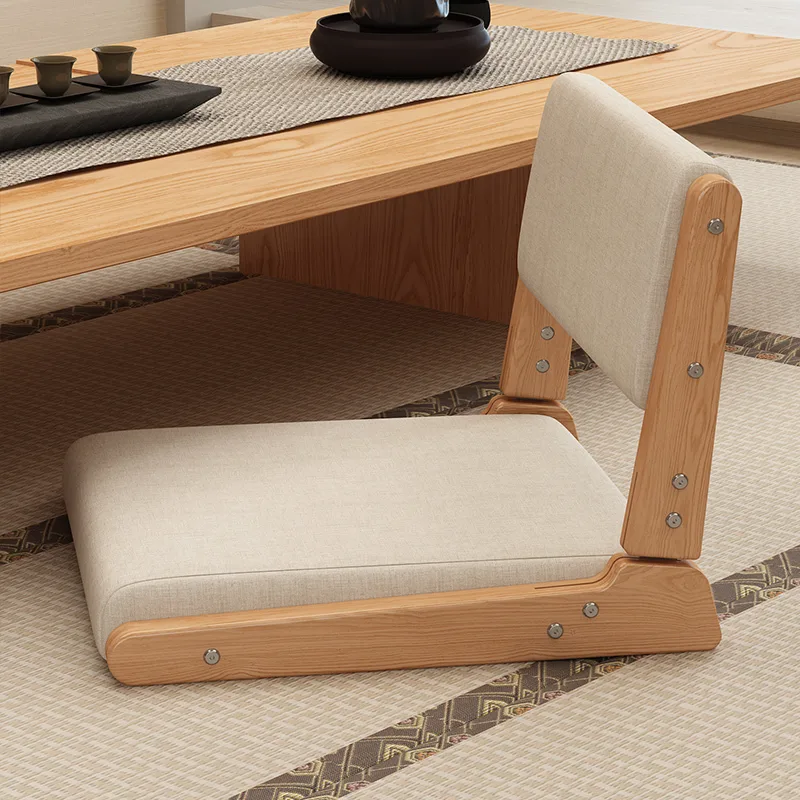
Low chairs on tatami: why the underside of the seat decides whether the frame stays sound, with the gaps, coatings and clearances we build to
The top of a low chair gets wiped every service. The underside sits 20 mm off a tatami mat for twenty years and never gets looked at, which is exactly where moisture collects. This is the gap geometry, hidden-face coating and clearance we build into every low chair frame, and the numbers behind each one.
Published by JPChairs · Chair manufacturer in Foshan, China · 2026-11-11
The floor is the wet side of a low chair
The tatami room is run at 55 to 65 percent relative humidity, and the mats themselves are a moisture buffer that releases water into the air under a load. An unheated floor slab in winter sits 2 to 4 degrees below room air. At 22 degrees and 60 percent relative humidity the dew point is 13.9 degrees, so any timber surface below that line collects condensation rather than releasing it.
The closed underside makes this worse than the room data suggests. A seat 450 by 400 mm at 300 mm height encloses about 0.054 cubic metres of air that can only exchange through 2 mm seams. We logged 8 to 12 points of relative humidity rise inside that cavity within 48 hours of a chair being placed on a mat in a 62 percent room. Timber sits at 8 to 10 percent moisture content at 60 percent and 20 degrees; every extra point of moisture content moves a 60 mm rail by 0.18 mm, and above 70 percent relative humidity mould spores germinate in 48 to 72 hours.
The target is the air under the seat staying within 5 relative humidity points of the room. If it does not, the frame is being asked to dry itself through the finish.
Gap geometry that actually moves air
Clearance is measured from the lowest rail or stretcher to the mat surface, with the chair loaded, not sitting empty in the showroom.
- 8 mm minimum under the lowest rail on a 400 mm seat height, 10 mm at 300 mm, because the shorter the leg the smaller the chimney effect that drives air up through the frame.
- Four corner pads of 5 mm felt compress to about 3 mm under 80 kg, so the pad thickness is not the gap.
- Slatted or open seat bases need 25 to 30 percent of the underside footprint open. Our slats run 40 mm wide on 25 mm gaps, which is enough for a vacuum nozzle and stays clear for years.
- The full skirt 20 mm deep around the seat box cuts exchange to almost nothing and is the single most common cause of a musty frame we see on returns.
Slot size matters as much as open area. Six millimetre slots give the same percentage on paper but clog with tatami dust in 6 to 9 months, and once clogged they read as a closed box. We hold the minimum opening at 20 mm.
Hidden faces and end grain: where the water enters
End grain absorbs three to four times faster than face grain, and on a low chair most end grain points straight down at the mat. In a 24 hour contact test a bare end grain face took 3 to 5 g of water against under 0.5 g on a sealed face, which is the whole difference between a frame that survives a humid season and one that opens a joint.
So the underside is finished, not left raw. One sealer plus one topcoat at 60 to 80 micrometres dry film across the bottom faces, two coats on every end grain face including the leg bottoms, and the same on the inside of the seat box. Dowel ends and screw holes get a wax plug rather than putty, because putty shrinks and cracks within a season and then holds water against the hole.
Cutting the finish cost out of the underside saves 0.30 to 0.45 USD per chair and costs a frame, and it is the first place a factory trims when a quote gets tight.
Floor contact, cleaning water and the 4 hour rule
Contact pressure decides how much water the mat and the frame share. A 30 mm pad carrying 20 kg reads about 280 kPa; a 100 mm runner carrying the same load reads 8 kPa. Low pressure spreads the load and lets the mat dry underneath, which is why our low chairs use runners on the two rear positions and pads at the front where the chair is dragged.
Cleaning is the other water source. A wiped low chair takes 200 to 300 ml of water, mostly around the leg bases and the seat edge. If the chair goes back on the mat within 10 minutes, that water is pushed into the 8 mm gap and has nowhere to evaporate. Housekeeping guidance we ship with the frames is 4 hours of air drying, or a dry wipe of the leg bottoms, before the chair goes back.
Bare metal glides against a tatami mat also rust-mark in a wet room within one season, so every floor contact point on these frames is either felt, nylon or a stainless glide with a plastic insert. The tatami chair moisture FAQ covers the questions buyers ask most about this side of the product.
What we test before a low chair ships
Three checks run on the pre-production sample and then on 1 in 50 frames in production.
- 72 hours at 40 degrees and 90 percent relative humidity. Weight gain must stay under 1.5 percent and the frame is inspected at 10x for surface mould, especially in the seat box corners.
- 24 hour wet contact: a water-soaked felt pad under each leg, then a check that no joint line has opened more than 0.2 mm.
- Gap gauge on the assembled chair: 8 mm clear under the lowest rail with 80 kg on the seat, measured with a flat bar rather than by eye.
Packing follows the same logic. Carton moisture content stays under 12 percent, desiccant goes in at 30 to 50 g per cubic metre, and any poly bag is micro-perforated at 0.3 percent of its area rather than sealed, because a sealed bag around a damp frame is a mould chamber.
The six lines to put in the purchase order
If a low chair is going into a humid room, these are the terms that decide whether it lasts:
- Minimum 8 mm clear under the lowest rail with the seat loaded, 10 mm at 300 mm seat height.
- Open underside area of 25 to 30 percent, minimum opening 20 mm, no full skirt.
- Underside sealed at 60 to 80 micrometres dry film, end grain two coats, wax plugs in dowel ends.
- Felt, nylon or stainless floor contacts only, no bare steel on tatami.
- 72 hour humidity test at 40 degrees and 90 percent with 1.5 percent weight gain limit.
- Micro-perforated bags and 30 to 50 g per cubic metre of desiccant.
Our low tatami chairs with ventilated seat bases are built to this schedule as standard, and the same treatment can be applied to any low frame we build on request.