Outdoor chair storage: off-season mould control
Outdoor chairs spend more hours in storage than in service, and most of the damage we get charged for happens while they are stacked in a back room. Mould, scuffed finishes and trapped moisture are storage problems, not weather problems.
Published by JPChairs · Chair manufacturer in Foshan, China · 2026-11-17
Mould needs three damp days, not a flood
Mould on stored chairs is a humidity problem. Spores are always present; what decides whether they colonise a seat is surface damp held long enough.
- Growth becomes visible when relative humidity at the surface stays above roughly 80% for 3 to 5 days; at 60% nothing colonises a clean frame.
- Food and drink residue is the food source: a seat wiped after service with a damp cloth only spreads sugar and starch deeper into seams.
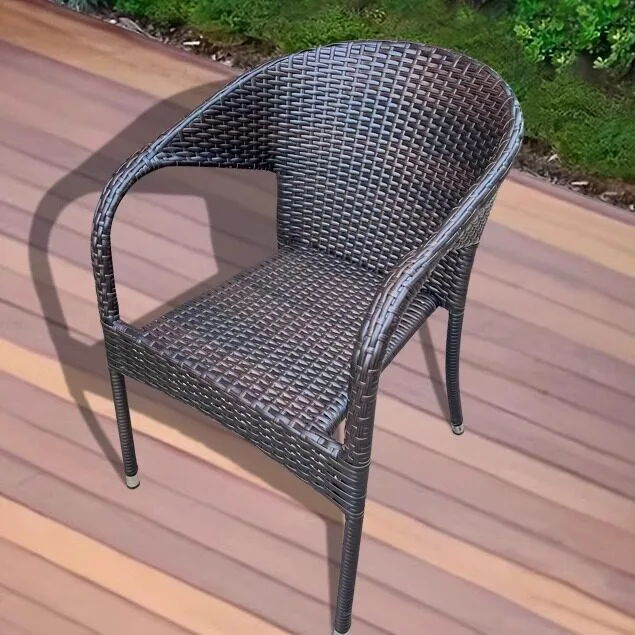
- Textile and woven seats hold moisture 4 to 8 times longer than bare frames, which is why mould almost always starts on the seat, not the legs.
- When the storage room cools overnight, damp air condenses on the coldest surfaces first, usually the floor-level frames and the underside of a stack.
Clean before stacking, not after
The cheapest anti-mould step is a proper clean before the stack goes up, and it is the step most venues skip.
- Wipe frames with 5% neutral detergent, rinse and dry; budget 5 to 10 minutes per chair, or one working day for a 120-seat terrace.
- Cushions and covers go to the wash separately at 30 C and 800 rpm, then flat-dry for 24 to 36 hours before any bagging.
- Check glides and welds during the same pass: the repair found at storage gets scheduled cheaply, the same repair found at reopening costs a rush order.
- Leave nothing organic on the frames; grass marks, leaf litter and dried spills in seams all feed mould once humidity rises.
How a stack traps its own weather
Stacking is what venues want and what moisture loves. These are the numbers we write into venue storage notes.
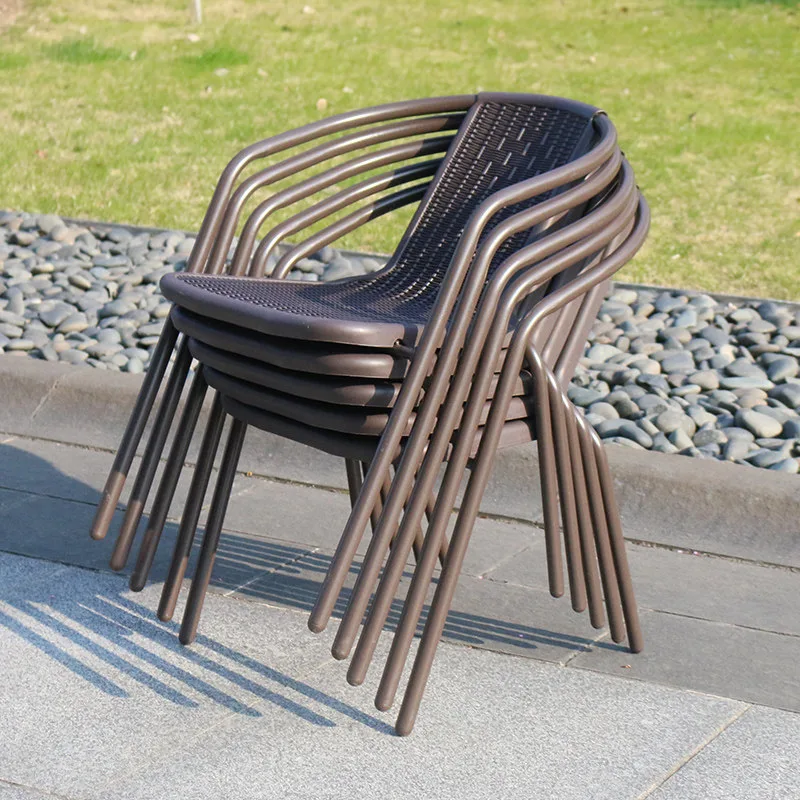
- Stack 5 to 8 chairs high with 40 to 60 mm air gaps between stacks; wall-to-wall contact holds a boundary layer of damp air that never dries.
- Never wrap a stack in polythene for more than 48 hours; inside sealed sheet the stack humidity climbs past 90% within 2 days even from a dry start.
- Keep the bottom chair off the floor. Concrete slabs wick moisture, and the lowest frame runs 2 to 4 C colder than the room, right at the dew point.
- Pallet racking beats floor stacking for long breaks: 4 to 6 stacks per bay with air moving past every level, and a 1,000-chair terrace fits in 30 to 35 square metres.
Covers: breathable sheet and desiccant
The cover has one job through the off-season: block dust while letting water vapour out.
- Nonwoven polypropylene at 80 to 120 g/m2 does that; cheap polythene does not, and neither does old canvas once its coating has cracked.
- Silica gel at 50 to 80 g per cubic metre of covered volume pulls stack humidity down 10 to 15 points in the first week, then needs replacing every 2 to 3 months.
- Zip the cover rather than tuck it; tucked corners wick ground moisture up the fabric like a candle wick.
- Inspect monthly: open one cover per 20 stacks, checking seat undersides for the first grey speckling, and rotate the stock so the same stack is not always at the back.
Drying hours before anything gets covered
Everything has to be dry before it is closed in, not dry while it is closed in.
- After wash-down, give frames 24 hours of open air; a hose-test wet frame bagged straight away holds 200 to 400 ml of water in its own crevices.
- Cushions need more: quick-dry fills are surface-dry in 45 to 60 minutes, standard foam cores take 2 to 3 days, and a moisture meter reading under 15% is the pass line.
- Spread cushions flat rather than folded; the fold line stores damp and reopens months later with a permanent crease.
Frame scuffs are the other storage cost
Mould is the visible storage failure; scuffed finishes are the silent one that shows up on the first booking sheet after reopening.
- Metal-on-metal stacking scuffs powder coat through the colour layer at the seat rails; felt or PE spacers every 4 to 5 chairs cut the marks to near zero.
- Repainting one scuffed rail takes 15 to 25 minutes of labour and 2 to 3 USD of coating; across 100 badly stacked chairs that is a full week of workshop time.
- Wooden outdoor frames get 2 mm felt pads between contact points and a fresh coat of hardwax oil before storage, which also seals end grain against the damp.
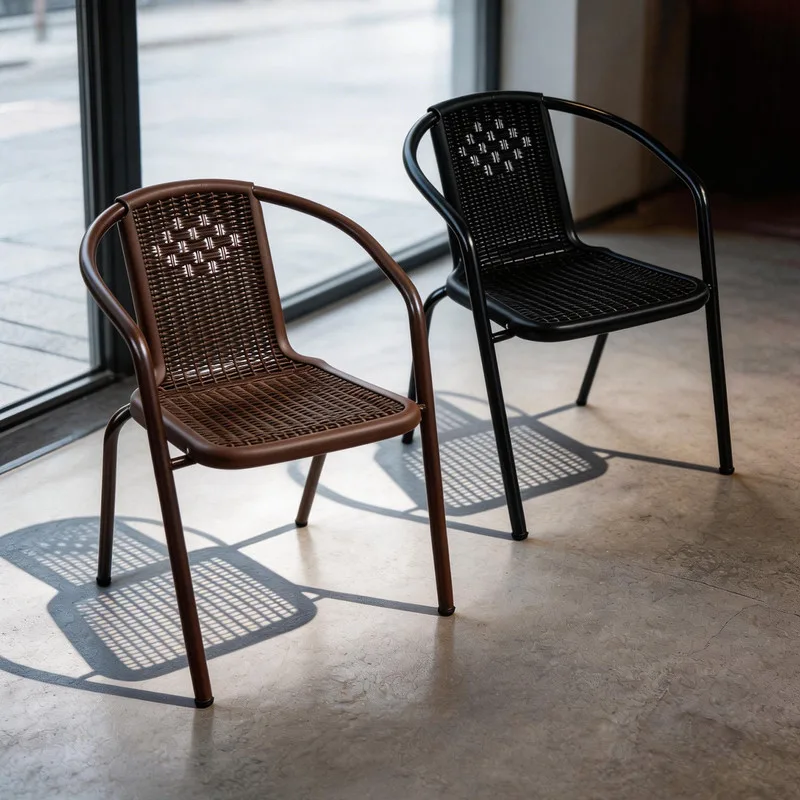
Storage is the off-season half of the product's life, and the chairs that come out of it clean are the ones built with drainage and coating choices in mind. The stackable outdoor patio chairs we build are designed around tight storage, and the same notes travel with the order as a condensation and mould FAQ.