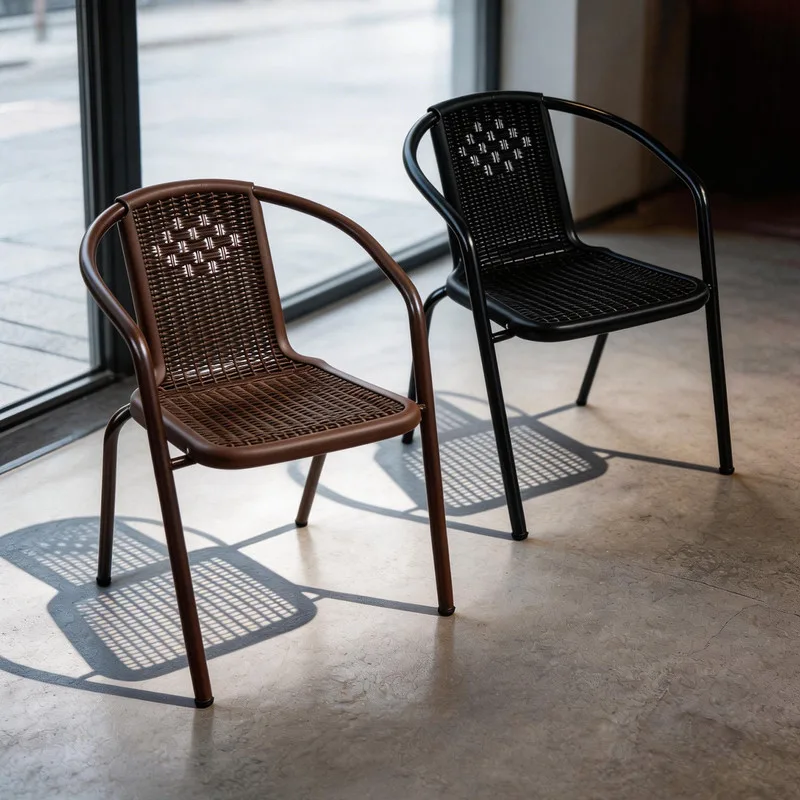
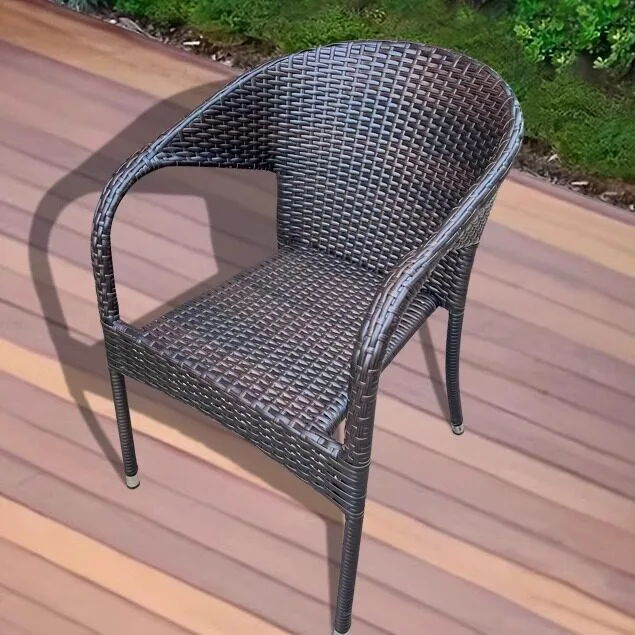
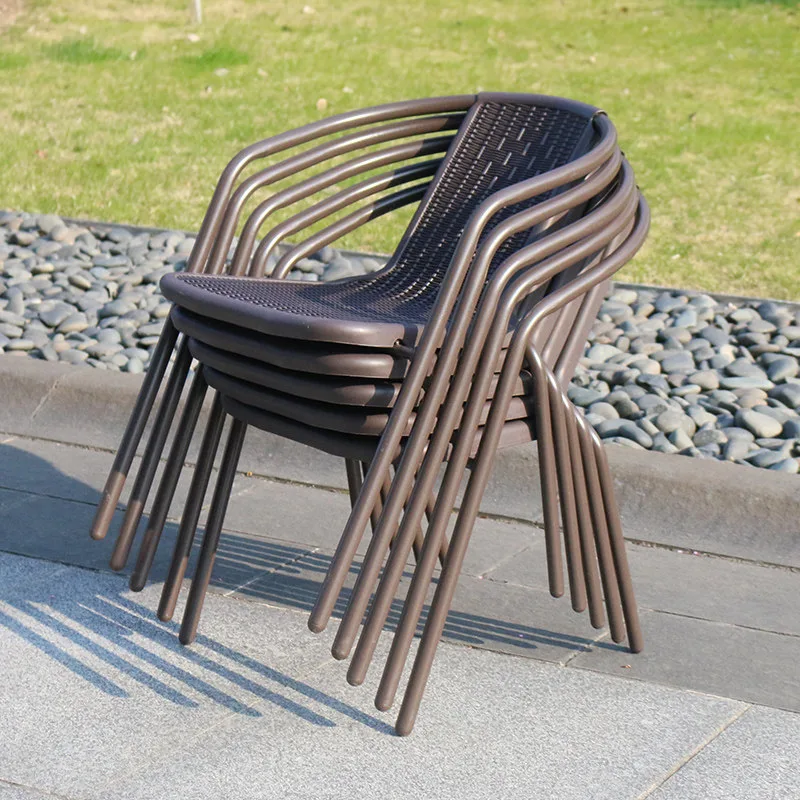
Outdoor chair frame tube drainage and sealing
A tubular frame is a closed container with whatever opening the welder left behind. On an outdoor chair it fills with rain, holds a warm wet volume all summer, and splits at a seam the first hard winter. Drainage and internal protection are cheap decisions made at the drawing stage; retrofitting them once the frame is powder coated is impossible.
Published by JPChairs · Chair manufacturer in Foshan, China · 2026-11-07
How much water a frame actually holds
A typical outdoor chair carries about 2.4 metres of 25 by 1.5 mm tube, which is a 22 mm internal bore and roughly 0.9 litres of capacity. A 20 mm rain event delivers more than 4 litres per chair, so any open tube top fills on the first night and stays filled until it drains or evaporates. Horizontal runs rarely fill completely but hold 20 to 40 ml each from condensation alone, enough to keep the bore wet for days at a time.
- Vertical tubes: fill to the first elbow from rain; this is the main intake.
- Open weld roots: a pinhole at a weld toe leaks slowly and drips inside the seat pan.
- Condensation: a warm day after a cold night leaves 20 to 40 ml per horizontal tube.
Drain holes: size, count and position
The first rule is that drain holes come in pairs. A single 6 mm hole can hold a water bead across the opening by surface tension, especially on a fresh powder coat, and nothing drains at all. Two holes 10 mm apart break the bridge and empty a filled 25 mm tube in under a minute.
- Size: 6 mm minimum on tube up to 25 mm; 8 mm on 32 mm tube and above.
- Position: at the four and eight o'clock points relative to the frame's standing lean, not at six o'clock, because outdoor frames tip back 3 to 5 degrees on gravel or decking.
- Long runs: horizontal tube over 600 mm gets a pair every 250 to 300 mm.
- Deburring: the inside burr is removed after drilling; it holds water and starts the rust ring that weeps down the frame.
Hole positions are marked on the drawing before coating, because a hole drilled after powder coating exposes bare steel on its edge and becomes the rust point instead.
End caps: push-in, welded and vented
Push-in plastic caps are the default because they are cheap and clean looking, but a tight cap seals the tube and traps whatever got in. A capped 0.9 litre frame holds 200 to 400 ml against the powder coat edge, which is exactly where the coating is thinnest. We cut a 3 mm vent slot in the top of every cap, or order caps moulded with vents, so the tube can breathe and drain.
- Vented push caps: standard for inland projects, no cost change.
- Welded dome caps: close the tube completely and pass coastal specs; they add 0.40 to 0.60 USD per frame in welding and dressing time.
- Snap-fit ribs: checked on the disassembly sample, because a cap that pops off in transit leaves the tube open inside the container.
Internal protection before the frame is closed
Powder coating covers the outside only; inside, the bore is bare steel unless something is applied before the frame is closed up. We spray 40 to 60 microns of zinc-rich primer through the open tube ends and drain the excess before cure, so the bore gets coated the same day as the outside. For projects promised to coastal or poolside duty beyond five years we add wax injection: 80 to 120 g of cavity wax pushed through the tube and displaced by air pressure so it films the internal walls. Where a buyer specifies galvanized tube for leg sections, the zinc layer runs 45 to 85 microns and the joint between galvanized and coated sections is isolated like any other dissimilar pair.
The sequencing rule is simple: internal treatment first, closure second. Once a cap is welded or pushed in, there is no second chance.
Trapped-water failure modes
Trapped water has three predictable failure modes, and all three arrive later as warranty photos.
- Freeze split: 0.9 litres of trapped water expands about 9 per cent when it freezes, and a tube split along the weld toe is the result after three hard cycles at minus 15 C.
- Weep staining: rust bleeding from the lowest cap or hole is the first sign buyers photograph, usually within 12 months on an unvented frame.
- Sloshing: a half-filled tube in a cafe chair announces itself on every use, which means the drain holes are missing or plugged by coating.
All three are silent on the day of packing, which is why the test below exists.
The trapped-water test we run
Every new frame design passes a trapped-water test before it is quoted, and one frame per batch is re-tested on the packing line.
- Fill test: 1 litre of water poured into the highest opening, held 30 seconds, then drained for 60 seconds; residual for the whole frame stays under 10 ml.
- Freeze cycle: three cycles to minus 15 C with the tube filled; no seam splitting and no cap distortion.
- Borescope check: internal view of one weld area per batch to confirm no spatter blocks a drain pair.
The frames built to this specification are listed under outdoor chairs built with self-draining frames. Both the drilling and the internal coating run in the factory tube fabrication shop, where drill jigs locate every drain pair to the drawing.