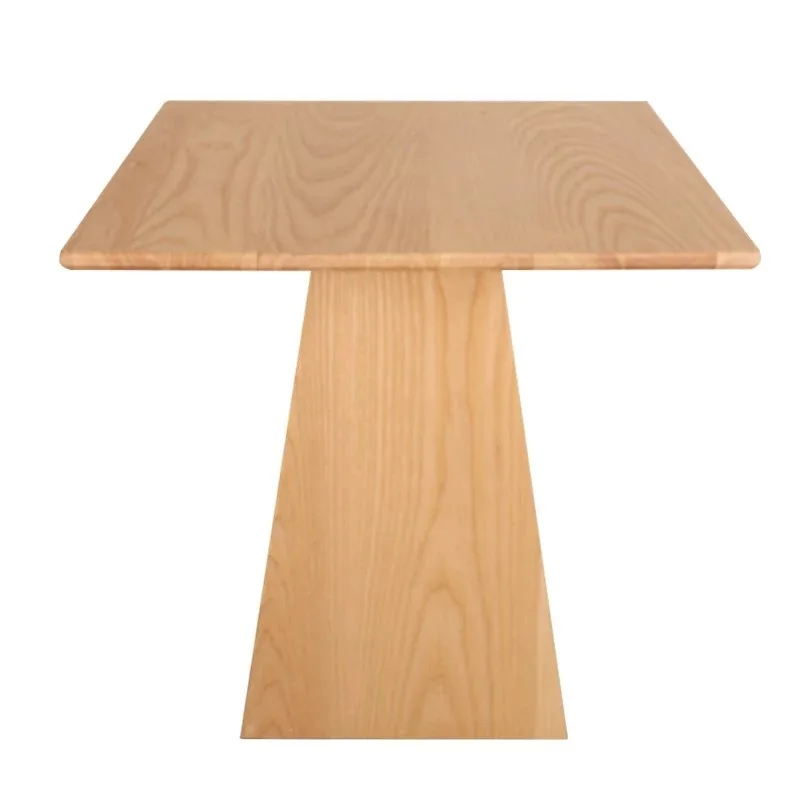
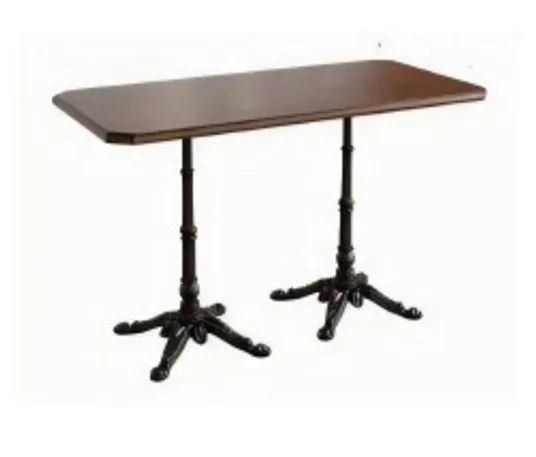
Table top substrates and edge banding, with the numbers
Restaurant table tops fail at the edge long before they fail in the middle. Choosing a core, a thickness and an edge band is four decisions, and each one has a number that decides whether the top lasts four years or twelve.
Published by JPChairs · Chair manufacturer in Foshan, China · 2026-10-24
The four cores we build tops on
Table tops are only as good as what is under the laminate. Four substrates cover almost every commercial job:
- MDF, 720 to 760 kg/m3: the default for a painted or laminated top. Flat, takes a 0.6 mm veneer without telegraphing, and about 30 per cent cheaper than birch plywood at 18 mm.
- Poplar or birch plywood, 15 / 18 / 21 mm: 480 to 560 kg/m3 for poplar, 640 to 700 for birch. Better screw holding and far better wet behaviour than MDF.
- Particleboard, 640 to 680 kg/m3: the cheapest sheet, but a raw 25 mm edge swells 8 to 12 per cent in a 24 hour soak, so we do not use it above a 900 mm span.
- Solid wood, 20 to 25 mm: ash, oak or beech at 8 to 12 per cent moisture content. Repairable, but it moves 2 to 4 mm across a 900 mm width between a dry winter and a wet summer.
Thickness, span and the sag limit
Sag is the failure a guest notices. The rule we build to is deflection no more than L/300 under a 40 kg point load at mid span, with the top supported only at its two ends:
- 900 mm span: 18 mm MDF is fine, about 3 mm of deflection against a 3 mm limit.
- 1,200 mm span: 25 mm MDF or 21 mm plywood. 18 mm MDF gives 6 to 7 mm against a 4 mm limit, and you can see it when someone leans on the middle.
- 1,600 mm and above: 25 mm plywood plus a 40 x 40 mm steel or 30 x 50 mm wood rail underneath, or deflection passes 8 mm.
- Pedestal bases: the base footprint should be at least 55 per cent of the top length, otherwise a 1,200 x 700 mm top tips at 18 kg on the overhang.
- Screw holding: 18 mm MDF pulls out at roughly 900 N on a 5 mm screw; 21 mm birch plywood at 1,400 N. That difference is why base fixings loosen first on MDF.
Tops built to those figures are listed on the commercial table tops.
Edge banding: thickness, glue and why it lifts
Three variables decide whether an edge survives service:
- Thickness: 0.4 mm PVC on a straight run, 2 mm ABS on a top that meets trays and trolleys. A 2 mm band absorbs an impact that splits a 0.4 mm one.
- Glue: EVA hot melt runs at 150 to 170 degrees Celsius and starts to creep above 60; PUR runs at 130 to 150, cures with moisture over 24 to 72 hours and holds to about 120. On a top near a pass or a coffee machine, PUR is worth the 12 to 18 per cent extra.
- Trim: a 2 mm radius on the top edge and a 0.3 to 0.5 mm scraped glue line. A square, un-radiused edge chips within 8 to 12 months of service.
- Peel strength: we pull test at 60 to 80 N per 25 mm of width. Anything under 40 N lifts in a hot kitchen.
The wear layer on top
The core sets the strength and the surface sets the life:
- High pressure laminate, 0.7 to 1.2 mm: the standard for a restaurant. A commercial grade HPL runs 350 to 400 Taber cycles before wear-through.
- Decorative laminate, 0.5 mm: 120 to 150 cycles. It belongs on a wall, not on a table that gets wiped 20 times a day.
- Melamine, 60 to 80 g/m2 paper: about half the price of HPL and a third of the life. Acceptable only if you plan to replace tops in year four.
- Wood veneer, 0.6 mm: under a PU lacquer at 80 to 120 g/m2 and a pencil hardness of H to 2H. Needs re-coating every 24 to 36 months in full sun.
- Solid wood, oiled or lacquered: 20 to 25 mm, sanded back two or three times over its life, roughly 10 to 14 years of service.
Heat, water and the first 300 mm
Most warranty claims start within 300 mm of the edge:
- 24 hour water soak: 18 mm MDF swells 6 to 10 per cent on a raw edge, plywood 2 to 4 per cent. A sealed edge roughly halves both.
- Hot cup test: a 90 to 100 degree cup leaves a ring on melamine in 20 to 40 minutes; on 1.0 mm HPL it takes 4 to 6 hours and usually wipes off.
- The fix: 2 mm ABS, PUR glue, a 0.2 mm backer on the underside, and 8 to 10 mm of the band turned under the top rather than flush cut.
- Under-top sealing: a 30 to 40 g/m2 edge sealer adds 2 to 3 years in a humid room at 70 per cent RH.
- Cost of the fix: about USD 1.80 to 2.60 a top, against USD 42 to 60 to replace a 1,200 mm laminated top.
What to put in the enquiry
Six lines, and the core cannot be quietly thinned between the sample and the bulk run:
- Core and thickness: 25 mm MDF or 21 mm birch plywood, with the density stated.
- Wear layer: 1.0 mm HPL, with the grade and the Taber figure if you have it.
- Edge: 2 mm ABS, PUR glue, 2 mm top radius.
- Span and base type: so the L/300 deflection can be checked before tooling.
- Duty: covers a day, indoors or out, and whether trays or trolleys hit the edge.
- Evidence: one top per 100 soaked for 24 hours, with the swell figure on the report.
The pressing and edge banding lines these run on are shown on the factory panel pressing lines, and the top sizes we stock are on the commercial dining tables.