Restaurant table bases: separating wobble, sag and tipping
Wobble, sag and tipping are three different faults that customers describe with the same word. One comes from the floor, one from top stiffness and one from base geometry, and each is fixed by a different line on the specification. This is how we separate them on a restaurant table before anything ships, and the numbers we put in the drawing so the problem does not come back.
Published by JPChairs · Chair manufacturer in Foshan, China · 2026-10-28
Three faults, one word
Replacing the wrong part never fixes the complaint, so name the fault first:
- Rocking: two diagonal feet lift and drop when the top is pressed. Measured with a feeler gauge the gap is usually 0.5 to 1.5 mm, and the cause is the floor or a glide out of adjustment rather than the base itself.
- Flexing: the top bends when someone leans on it. A 25 mm particleboard top across a 1,200 mm span can move 6 to 9 mm under a 50 kg elbow load.
- Tipping: the assembly rotates about a base edge. That is a footprint problem, and adding weight alone rarely solves it.
The first check takes thirty seconds. Press each corner in turn with roughly 5 kg and note which of the three appears, because every decision downstream depends on the answer.
Footprint: how much base a top actually needs
Table tops are beams with supports, and the distance between those supports decides everything else:
- 600 to 700 mm tops: a single pedestal with a spread of 380 to 450 mm, roughly 60 to 65 per cent of the top diameter.
- 800 mm square: base spread of 500 mm or more.
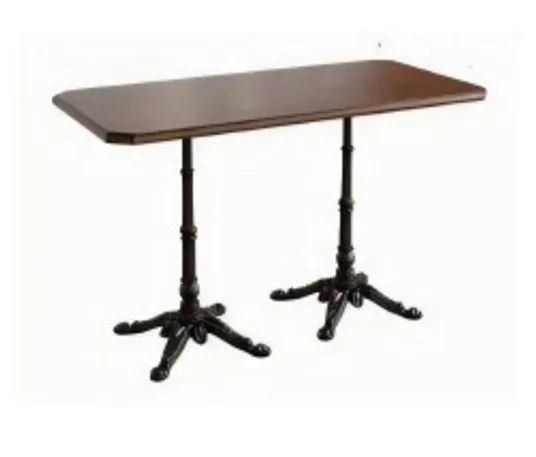
- 1,200 x 800 mm tops: either a twin post base with each post 250 to 300 mm from the end, or a four arm spider at about 700 x 450 mm.
- Overhang: keep every edge within 250 to 300 mm of its nearest support. Past 300 mm the corner acts as a lever and the table feels light even when the base is heavy.
Mass follows intent rather than driving it: 12 to 18 kg of cast iron for 600 to 800 mm tops, 18 to 26 kg for a twin post arrangement, and 6 to 9 kg only when the feet are widely spread or bolted to the floor.
Tipping: a moment equation worth doing once
Stability is lever arithmetic, and doing it once per design saves a year of complaints:
- Overturning moment: 100 N of sideways force applied at the edge of a 700 mm top whose surface sits at 740 mm gives 74 Nm.
- Restoring moment: assembly weight times half the base width. A 36 kg top and base with a 450 mm base gives 353 N x 0.225 m, which is 79 Nm, leaving only 7 per cent margin.
- Widen the base: the same 36 kg assembly on a 550 mm base reaches 97 Nm, a 31 per cent margin, for a change of 100 mm and about 2 kg of casting.
- The trap: adding mass to the top without widening the base makes matters worse in a hurry, because the valuable part of that equation is the reaction distance, not the weight.
This is why pedestal tables for busy venues are specified with the widest fleets accept at knee height rather than the heaviest casting the freight budget allows.
Levelling hardware: thread travel matters more than the glide
Most wobble complaints end at this line item, and it is still worth under a dollar a table:
- Thread: standard M8 levellers with a 30 mm stud give about plus or minus 10 mm of travel. Specify M10 with a 40 mm stud for any table going onto timber, old tile or a raised threshold.
- Floor reality: restaurant floors commonly vary 3 to 6 mm over 2 metres, so 10 mm of travel is comfortable while 5 mm leaves one foot permanently in the air.
- Foot material: nylon for hard floors, felt faced for stone, stainless for wet areas, and a 30 to 40 mm diameter so the load spreads instead of denting vinyl.
- Lock: a jam nut costs cents and stops the leveller walking down through 800 to 1,200 cleaning cycles per year.
We ship a spare leveller per ten tables, which is a stated line on the order rather than a favour.
Deflection: the straightedge and dial test
Flex is measured rather than debated. Our bench procedure takes about fifteen minutes per sample:
- Set up: support the top on its real base and lay a straightedge along the long axis.
- Load: 50 kg over a 200 x 200 mm pad at the centre of the top, held for 30 minutes.
- Limit: span divided by 300, so 4.0 mm on 1,200 mm or 2.3 mm on 700 mm.
- Recovery: remove the load and read permanent set after 30 minutes. Anything above 10 per cent of the measured deflection will grow with every week of service.
- Remedy: a 25 mm top reaching 5 to 7 mm needs either 30 to 40 mm thickness, a 40 x 40 mm steel sub frame, or a support point moved closer to centre.
Substrate and edge selection drive the stiffness number, so the two are always decided together. Current standard tops and their tested spans are listed with the commercial dining tables.
The six lines that belong in your table specification
These lines remove most wobble complaints before the goods leave the factory, and all six are measurable at inspection:
- Base spread: nominate the footprint in mm, not a supplier part number.
- Base mass: a minimum in kg plus the material, because cast iron and pressed steel behave very differently at identical weight.
- Leveller: thread size, stud length and foot diameter.
- Deflection limit: span over 300 under 50 kg at centre for 30 minutes, with permanent set below 10 per cent.
- Top thickness: nominal plus tolerance, and the position of any sub frame.
- Assembly: bolt size, pilot hole and torque, normally M8 at 12 to 15 Nm into a threaded insert.
Base drawings go out with every sample, and changes to geometry or finish run through the OEM drawing approval process. Height coordination between tables and chairs is covered on the table and chair height FAQ.