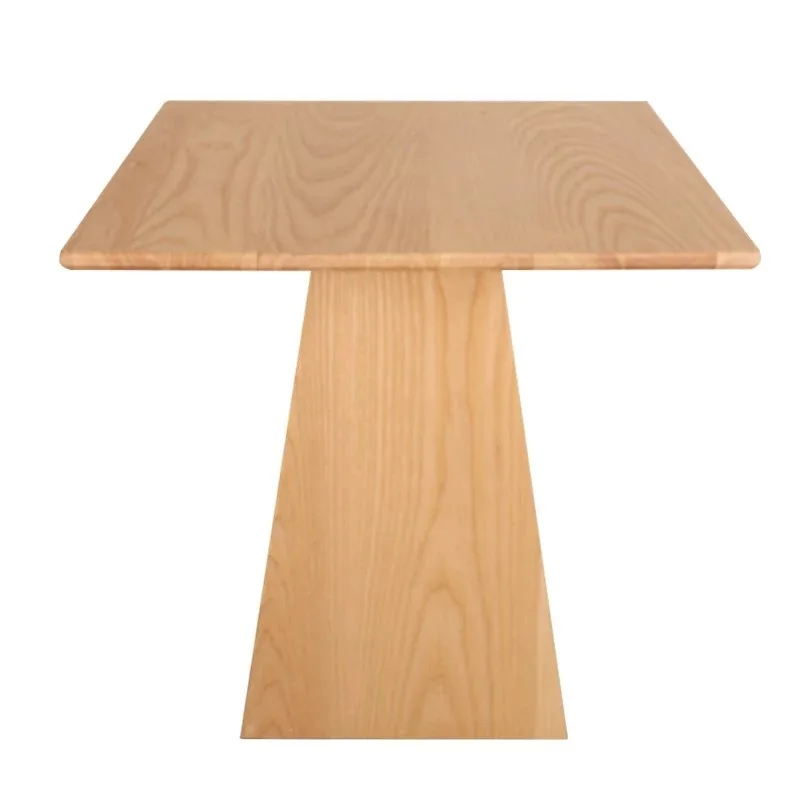
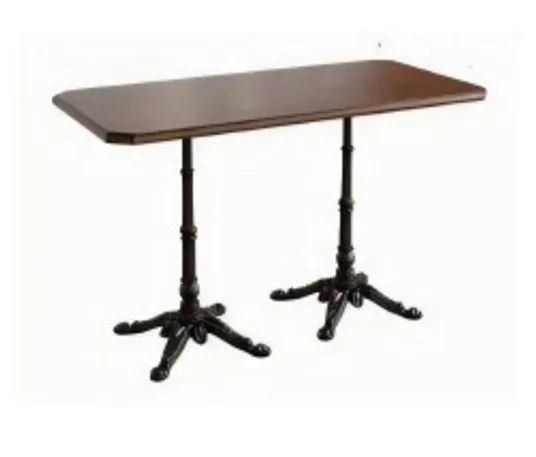
Table top edge profiles and impact resistance
On a commercial table the edge takes the hits, not the surface. A two-millimetre change in corner radius or a band that is 1.5 mm thinner moves the failure point from a cosmetic scuff to a replaced top.
Published by JPChairs · Chair manufacturer in Foshan, China · 2026-11-06
The edge fails long before the surface does
We drop-test tops with a 1 kg steel ball from 500 mm at the corner, the long edge midpoint and 100 mm in from the corner. The results separate profiles far more cleanly than any brochure description.
- Square edge, 1 mm radius: chips at 250 to 300 mm drop height; the chip exposes core and the repair is visible.
- 1.5 mm radius with 2 mm ABS: survives 450 to 500 mm with a dent but no exposure.
- Bullnose R9 to R12: survives 800 mm and beyond, because the load is spread over 18 to 24 mm of arc instead of a line.
- Unsealed core: a 3 mm chip that takes on water can swell the core 8 to 12 per cent in a 24 hour soak.
That is the whole argument for radius: not appearance, but where the impact energy goes.
Five profiles and where each one belongs
Profile choice should follow traffic and cleaning method, not the render. These are the five we quote most.
- Square with 1.0 to 1.5 mm radius: cafes and meeting rooms, cheapest, best for tight butt joints against a wall.
- 45 degree chamfer, 3 mm: reads as a thin top, but the chamfer face is a narrow band that chips at 300 to 350 mm.
- Full bullnose R9 to R12: hotels, banqueting, anywhere chairs get dragged. Our default for hospitality.
- Half bullnose R9: outside corners only, so the top sits flush against a banquette on the inner side.
- Postform or waterfall bend: R25 to R40 continuous, no joint to fail, but the laminate must be rated for the bend radius.
Corner radius on the plan view matters as much: 60 to 100 mm on a 900 mm square top removes the corner that hips and trolleys hit.
Band thickness, glue line and water
Edge banding is sold by thickness and specified by nobody. It should be specified.
- 0.5 mm PVC: dents at 8 to 10 J of edge impact and cannot be repaired, only replaced.
- 2 mm ABS: takes about 20 J, holds shape at 60 to 70 C wash temperatures, and is the thinnest band we will put on a hospitality top.
- 3 mm ABS or 6 to 8 mm solid wood: used where the edge is a design feature; solid wood moves 0.3 to 0.5 mm seasonally at 4 to 6 per cent moisture content, so it needs a shadow gap rather than a flush joint.
- Glue: PUR at 120 to 140 g per square metre with a glue line under 0.1 mm. A visible glue line is a water path, and a water path is how a band lifts in a dishwasher-adjacent kitchen.
Every top gets a full perimeter seal, including the underside, because moisture enters an MDF core from below as readily as from a chipped edge.
The impact protocol we run before shipping
Three samples per batch, six impact points each, all photographed and logged. It takes about 40 minutes and it has stopped more shipments than any surface inspection.
- Corner drop: 1 kg ball, 500 mm, on the plan-view corner radius.
- Edge drop: 1 kg ball, 500 mm, on the long edge at mid-span, where deflection is highest.
- Side impact: 20 J pendulum or swing test on the band, checking for delamination along 100 mm.
- Pass criteria: no chip deeper than 2 mm, no exposed core, no crack propagating into the laminate, no band lift.
- Load case: 100 kg distributed at the centre of a 1800 mm span, deflection under L/300, which is 6 mm.
Batches that pass on geometry but fail on band lift almost always trace back to glue temperature on a cold morning.
Repair limits: what a technician can and cannot fix
Every hospitality client eventually asks for a repair kit. The honest answer is a threshold, not a kit.
- Up to 3 mm chip in the band or coating: wax or epoxy stick, colour matched to within 1.5 delta E, 4 minutes per repair, invisible from 1 m.
- 3 to 8 mm chip reaching core: seal with two-part epoxy first, then fill; the seal is what stops the swell, so it is not optional.
- Over 8 mm or a lifted band: replace the top. A patched band lifts again within one cleaning cycle.
- Re-gluing a lifted band: hot air at 180 C for 90 seconds, clamp 60 seconds, then seal the end grain.
Documenting each repair with a photo and a date turns a maintenance budget into a number a buyer can forecast.
What to put in the table top specification
A table top spec that only states dimensions and laminate grade leaves the two most expensive variables open. Add these and the quote becomes comparable between suppliers.
- Top build: 25 mm or 30 mm core, density 720 to 760 kg per cubic metre for MDF.
- Edge: profile name plus radius, band material and thickness, glue type.
- Corner: plan-view radius in millimetres.
- Impact: 1 kg at 500 mm, pass criteria as above.
- Tolerance: flatness 1.5 mm per metre, twist 1 mm across a 900 mm diagonal.
The tops we build to these numbers are listed under commercial table tops with moulded edges, and the profile geometry is agreed on drawing through OEM edge profile drawings before a sample is cut. For delivery damage questions, the table top damage FAQ covers what is covered and what is not.