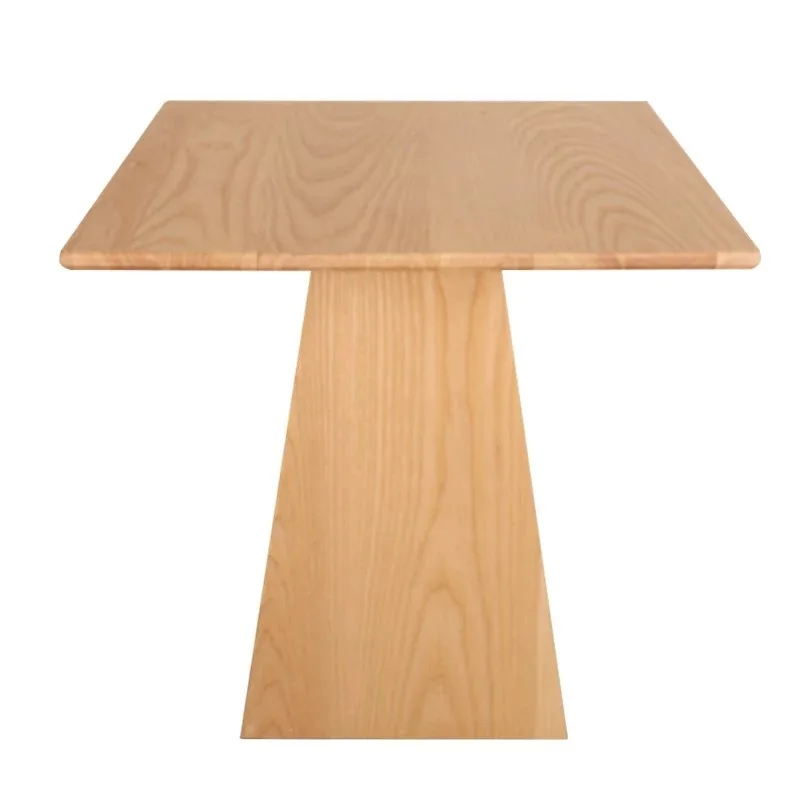
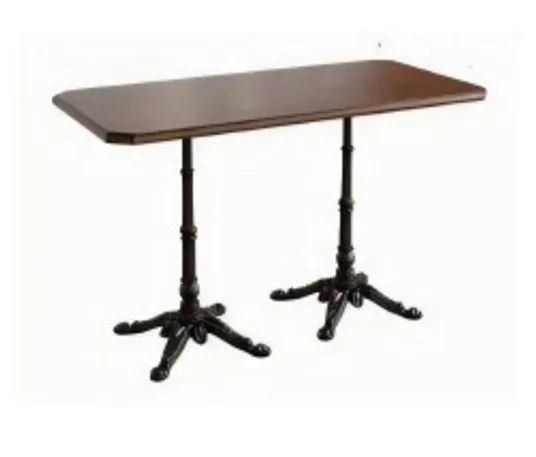
Table tops and bases: how much movement to allow, which connector gives it, and the hole and torque tolerances we build to
The table top that is screwed dead flat to a steel frame is a table top that cracks in its second winter. The joint between top and base has to carry 8 to 12 mm of seasonal movement on solid timber, and doing that with a tighter screw is the wrong answer. This is the connector schedule, hole tolerance and torque values we build to.
Published by JPChairs · Chair manufacturer in Foshan, China · 2026-11-10
Why a top screwed flat to a frame cracks
The 900 mm flat-sawn oak top moves 0.30 percent of its width for every 1 percent change in moisture content across the grain. Indoors that swing runs 7 to 12 percent over a year, so the same top changes width by 12 mm between a dry January and a humid August. Screwed dead to a steel frame, those 12 mm have nowhere to go. The panel picks up 4 to 6 kg per square millimetre of restrained stress at the fixing line and starts to check at the ends within two heating seasons, usually 14 to 20 months after delivery.
The fix is not a thicker top or a heavier screw, it is deliberate play. Every top we build gets 8 to 12 mm of movement allowance along the grain and 3 mm across it, taken up by the connector rather than by the timber.
Four connectors and how much travel each gives
We use four fixings, chosen by top material and by how often the base comes off.
- Z-clip, 20 gauge steel, 12 mm of slot travel, 0.06 to 0.10 USD each. Six clips on a 900 by 900 mm top at 250 mm centres; the clip screws to the base rail and hooks into an 8 mm kerf routed in the underside.
- Figure-8 fastener, 3 mm of travel each way, 0.12 to 0.18 USD, used where neither the top nor the rail can be routed.
- Through-bolt M8 in an 11 mm slot, 3 mm of play per side, 0.35 to 0.55 USD per fixing including a threaded insert. The only type we use where the client insists on a fully demountable top.
- Corner bracket, 40 by 40 by 3 mm, 10.5 mm holes, M8 into a steel rail at 15 to 18 Nm. Travel is whatever the hole gives, so it is a last choice on solid timber.
Engineered cores move far less: an 18 mm plywood core with HPL faces shifts 2 mm across 900 mm over the same moisture swing, so a 3 mm slot is enough. Do not apply the solid timber figure to a veneered panel and over-slot it, because a top with 12 mm of play on a stable core slides under the hand every time someone leans on it.
Hole positions and the tolerances that hold
Base rail holes are drilled at plus or minus 1.0 mm, top holes at plus or minus 0.5 mm, and every slot is cut 3 mm longer than the bolt on each side. Fixings sit 40 to 60 mm in from the edge; at 25 mm the router kerf blows out the edge on oak and the only repair is a new top.
The threaded insert matters more than the bolt. An M8 E-nut in 18 mm plywood pulls out at around 1,200 N, the same nut in MDF holds 900 N, and a machine screw driven straight into 18 mm particleboard holds 400 N and strips the first time somebody over-torques it. We specify inserts on anything that will be taken apart more than twice.
Torque is where most assembly damage happens: M8 at 15 to 18 Nm, M6 at 8 to 10 Nm. Above 20 Nm the washer crushes the 0.4 mm ply face under the HPL and the top shows a 6 mm dimple that no clamp will ever flatten.
What the assembly bench checks
Four numbers on the final bench. Top rotation under a 5 kg corner push, read on a dial gauge, stays under 2 mm. The four feet on a granite plate sit within 1.0 mm of each other. The gap between top and base rail, 0.5 to 1.0 mm on a felt washer, has to be present on all four sides, because a hard contact there is what squeaks at three in the morning in a restaurant. And a 200 cycle side load of 30 kg at seat height must produce no audible movement.
Sampling is 1 in 20 on the bench and 100 percent on the rotation check, because a loose clip is a two minute fix in Foshan and a service call in another country.
Field failures and what each costs to fix
Three patterns come back. A clip that was never seated shows as 3 to 5 mm of slide and a 2 mm corner lift at 18 months; a re-torque kit and 10 minutes fixes it. An over-torqued through-bolt shows as a star crack radiating 15 to 25 mm from the hole at 6 to 10 months, a 60 to 90 minute repair with a 40 to 60 USD patch, and the client sees it every service. Water standing in an open fixing hole swells the core and produces an 8 mm weep line on the frame at 12 months, which is why every hole gets a 2 mm sealed washer before the bolt goes in.
We recommend a six month re-torque walk on any venue above 200 covers. On our own record of installed tops, 15 percent of fixings had moved by that point, all of them on solid timber and none on engineered cores.
What to put on the fixing drawing
Five lines save a factory argument later: slot direction parallel to the grain movement, clip schedule with spacing and quantity, torque value per bolt size, insert type and pull-out figure, and a 2 percent spare fixing allowance in the carton. Tops ship inverted on 3 mm foam with fixings bagged and labelled per table, so a 40 table install does not stall over a bag of mixed screws.
The commercial table tops with floating fixings we build carry that schedule on the shop drawing. For the drawing format and approval loop, our OEM top fixing drawings page shows what a signed-off sheet contains.