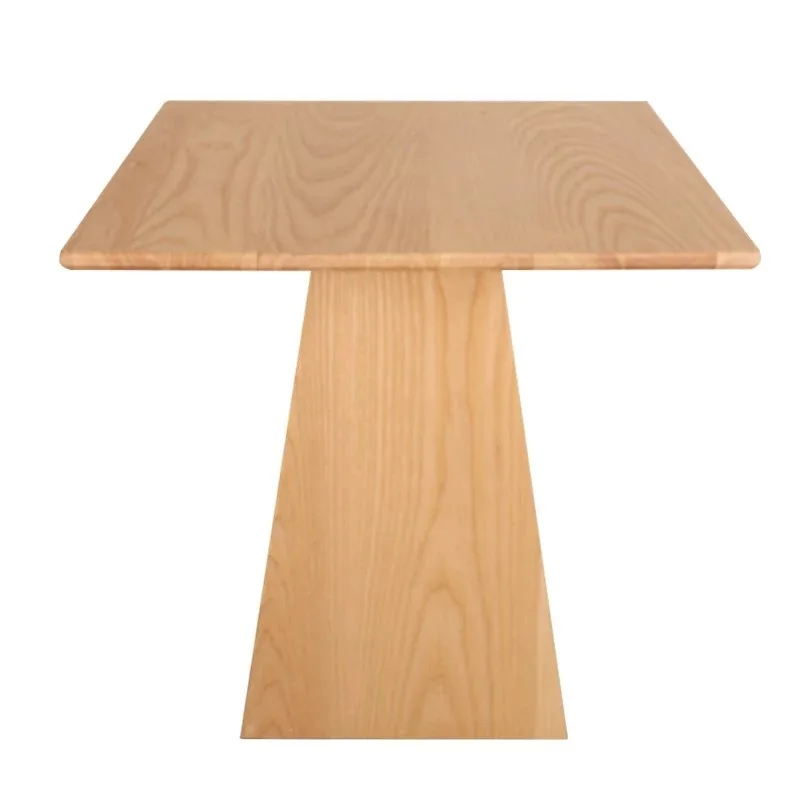
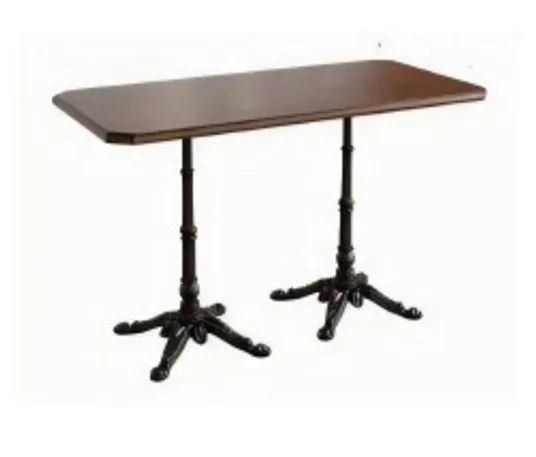
Round or square: what each top shape really costs in sheet yield, banding metres, seat count and container space
Two tops of the same nominal size, one round and one square, are not the same product commercially. One uses 51 percent of the sheet it is cut from and the other 64 percent, and that gap runs through banding, weight, packing and the number of covers a floor plan can hold. Here is the arithmetic we run before quoting either shape.
Published by JPChairs · Chair manufacturer in Foshan, China · 2026-11-11
Sheet yield: the first number that matters
Start with a 1220 by 2440 mm sheet, which is 2.98 square metres, and a saw kerf of 3.2 mm. On that sheet an 800 mm round top yields three pieces and an 800 mm square yields three pieces, so a buyer comparing counts per sheet sees no difference. Area tells the real story: 1.51 square metres of round tops against 1.92 square metres of square tops, 50.7 percent yield against 64.5 percent.
Across 100 tops that gap is 197 sheets against 155, or 42 sheets of 21 mm board. At 28 USD a sheet that is about 1,180 USD of material that goes into the offcut bin. Hexagonal nesting buys back 8 to 10 points of yield on round tops if the CNC router is set up for it, but the tops then need a second operation to trim the tangents.
Solid timber changes the maths. An 800 mm round top needs four 210 mm strips glued up and machined back to a circle with 8 percent waste at the rim; the square version needs four 205 mm strips with 3 percent waste.
Banding metres per top
Edge banding runs off the perimeter, not the area. An 800 mm round top carries 2,513 mm of banding, an 800 mm square carries 3,200 mm, so the square needs 27 percent more banding for the same seating footprint.
- 2 mm ABS at 0.55 to 0.75 USD per metre: 1.38 USD on the round, 1.76 USD on the square.
- Machine time: 11 seconds on the round with a radius bander, 14 seconds on the square.
- Joint count: one on a round, three or four on a square if the banding is applied by hand, and every joint is a place where a 0.1 mm glue line shows under a light.
Round tops need a radius banding machine or a very good hand operator, and small shops that lack the machine will quote a square top 15 to 20 percent cheaper simply because they can run it on a straight edge bander.
Seats per top and covers per square metre
Allow 600 mm of perimeter per cover for a four-top. An 800 mm round has 2,513 mm of perimeter, which is four covers with 113 mm of slack; a 1,000 mm round has 3,142 mm and takes five; an 800 mm square has 3,200 mm of perimeter but the corners are unusable, so it also seats four.
Per square metre of top the round wins clearly: 7.9 covers per square metre against 6.25 for the square. On the floor plan the advantage narrows, because round tables need 1,100 mm centre to centre to keep chair backs apart, against 1,050 mm for square. Over a 6 by 5 metre dining area that difference costs about two covers, which is roughly the same as the area the round saves.
Where the square does win is along a banquette or a wall: pushed against a fixed seat, two sides of the square are not used for access, so a 1200 by 800 mm top gives six covers at 6.25 per square metre with a much simpler chair layout than two rounds of the same area.
Overhang, base footprint and the corner lever
The top only stays level because the base is wide enough underneath it. On an 800 mm round over a 550 mm four-leg base the overhang is 125 mm all round, which is comfortable: a 60 kg guest leaning on the edge puts about 34 kg of lift on the far legs, well inside the frame weight.
The same 550 mm base under an 800 mm square produces a 177 mm corner overhang because the corner sits at 566 mm from the centre. That is a 1.4 times longer lever, so a 30 kg lean at the corner behaves like 42 kg, and the table rocks before the frame gives. Square tops over 750 mm therefore get a 620 mm base or a diagonal brace; if the design will not allow that, we fit adjustable feet with plus or minus 10 mm of travel so the rock can at least be taken out on site.
Aisles feel the shape too. An 800 mm square turned 45 degrees puts its corner 131 mm further into a walkway than the round does, which is the difference between a 900 mm clear aisle and a 1,030 mm one on the same floor plan.
Packing, weight and container counts
The 21 mm MDF top weighs 7.9 kg as an 800 mm round and 10.1 kg as an 800 mm square, a 28 percent difference that shows up in freight and in what one person can carry during a refit.
- Volume per top: 0.0151 cubic metres round, 0.0192 cubic metres square.
- Stacked 20 high with 5 mm interleaves in a ply crate, a round crate runs 0.36 cubic metres, a square crate 0.46.
- In a 40 foot high cube at 68 cubic metres usable, that is roughly 880 round tops against 690 square ones before bases are loaded.
Round tops stack well because there is no corner to catch, but they slide, so every layer needs a 5 mm interleaf and the crate needs corner blocks rather than straps alone.
Our round and square commercial table tops are quoted from the same sheet calculation, so the price difference you see between shapes is material and machine time rather than an arbitrary step. For a mixed order, sending us a floor plan lets us work the shape mix before the OEM table top drawings are issued.
Choosing the shape by room, not by taste
The working rule we give buyers is 80 percent rectangles and 20 percent rounds for a full-service restaurant, moved either way by three things.
- Wall and banquette seating: squares, because two sides are against something and the perimeter is free for covers.
- Freestanding four-tops in the middle of the floor: rounds, because there is no corner for a chair back to catch and no corner in the aisle.
- Rooms under 40 square metres: squares, since the 1,100 mm round spacing costs covers that a small floor cannot give up.
Groups also matter. Two 800 mm rounds pushed together seat eight but leave a 150 mm gap that food drops through; a 1200 by 800 and an 800 square pushed together seat eight with a straight joint. If the room takes bookings for large parties, the square mix is the one to specify.