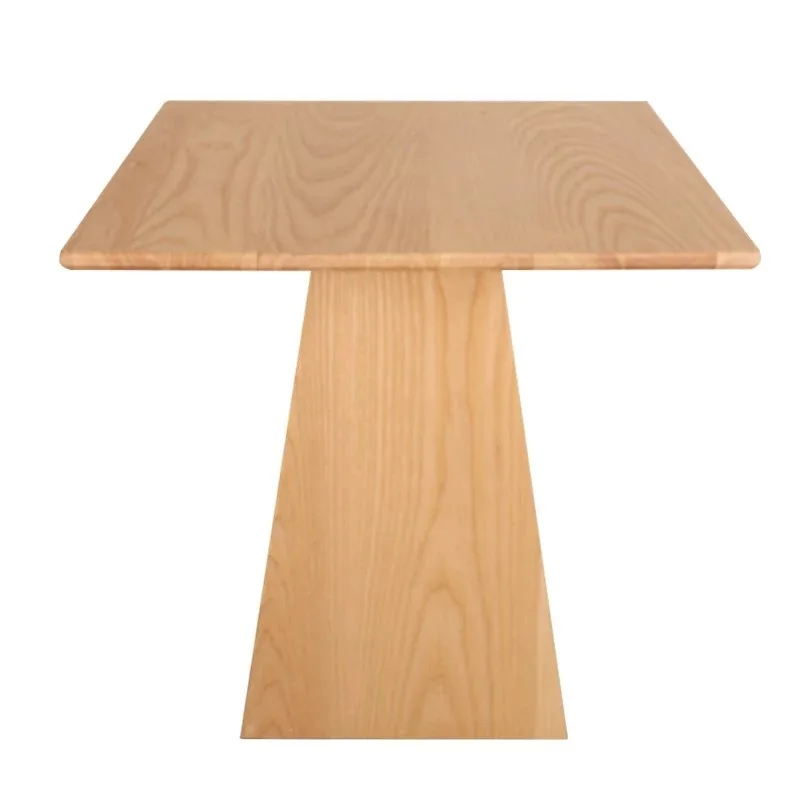
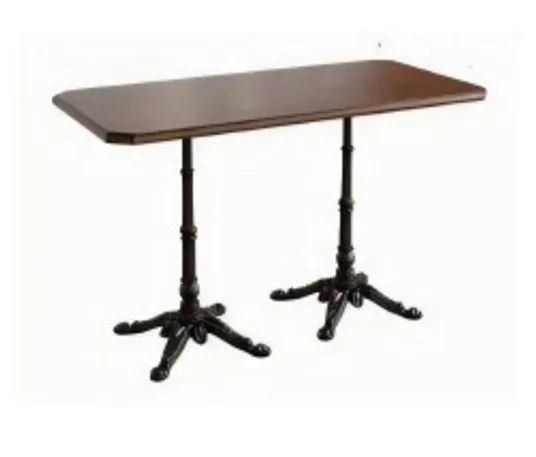
Flip-top tables: hinge play, latch strength and wobble control
The flip-top table is a hinge with a tabletop bolted to it. Buyers compare tops, but the part that ends a fleet early is the hardware: 0.3 mm of hinge play becomes 3 mm of visible droop at the far edge, and a latch that lets go under a hip is a warranty claim, not a nuisance.
Published by JPChairs · Chair manufacturer in Foshan, China · 2026-11-20
Storage maths that justifies the hardware
Flip-top tables pay back in the storage room before they pay back in the dining room. A 1200 x 700 mm four-seat table with a fixed top stands 760 mm high and ships at 0.64 m3 per carton. The same top on a folding frame packs at 1,280 x 780 x 115 mm, or 0.115 m3, which is a 5.5 to 1 volume ratio.
- 40HC with fixed tables: about 380 units at 0.64 m3 packed. With flip tops: about 2,050 units, though weight limit at 26,500 kg stops the count nearer 1,600.
- Back of house: 60 folded tables stand on a 1,200 x 800 mm dolly inside 1.0 m2, against 4.6 m2 for the same 60 stacked flat.
- Turnover: two staff reset a ten-table private room in 8 minutes with flip tops, 22 to 25 minutes with fixed tops and trolleys.
- The saving is real, but a hinge that cannot carry the top in service moves the cost from storage to replacement inside 36 months.
Where hinge play comes from
Play is specified in millimetres but felt in degrees. A hinge set 60 mm in from the table edge with 0.3 mm of radial clearance swings 0.005 rad, and at the 600 mm mark that is 3 mm of droop a guest can see and feel through a glass.
- Continuous piano hinge, 1.5 mm leaf: best stiffness per dollar, needs a straight 1,200 mm edge within 0.5 mm, otherwise the leaf fights the top and the screws work loose.
- Three butt hinges, 2.0 mm leaf at 400 mm centres: easier to fit on warped tops, 40 percent less torsional stiffness than a continuous hinge.
- Pivoting bracket under the top: hides the mechanism, but every bracket introduces two more clearances, so the stack of play is 0.6 to 0.9 mm instead of 0.3 mm.
- Fixings matter as much as the hinge: M6 x 16 into an 18 mm birch ply core with an E-nut holds 1,200 N in pull-out, a direct screw into 18 mm MDF holds 450 to 550 N and strips after two refits.
- Support spacing stays at or under 400 mm. Past that the leaf bows between screws and the seam opens under a 30 kg edge load.
Latch strength and the accidental fold
The latch is a safety part. Guests lean on the free edge, staff drag tables by the top, and a top that folds under a hip at 300 N is a claim. We specify latch hold at 180 to 260 N and test the assembly with a horizontal push of 300 N at the free edge, held 10 seconds, with no release.
- Ball detent alone holds 60 to 90 N. Fine for a domestic card table, too light for a restaurant.
- Spring latch with an 8 mm pin holds 180 to 260 N and wears 0.2 mm over 10,000 cycles, which is still inside tolerance.
- Over-centre cam latch holds 400 N and up, and costs 1.40 to 2.10 USD more per table than a spring latch.
- Finger traps: the gap between the top and the frame must stay under 5 mm or over 25 mm through the whole fold arc, checked with a 5 mm and a 25 mm gauge.
Flatness across the seam
An open flip-top table reads as one surface or as two halves. Guests judge it at the seam, and a step of 1 mm catches a glass base and rocks it. Target seam gap is 0.8 to 1.2 mm and step is 0.5 mm maximum, measured with a straightedge and a feeler at three points along the 700 mm span.
- Flatness over 1,200 mm: 1.2 mm maximum bow, measured after 48 hours of conditioning, not at the bench.
- Edge load: 30 kg placed 50 mm from the free edge deflects 3 mm maximum and returns to under 0.5 mm in 1 minute.
- Closed position rests on two 25 mm standoffs with 2 mm rubber bumpers, compressed to 1.5 mm, so the top does not slap the frame in transit.
- Seam alignment is set by the hinge, not by the top: hinge axis to top edge at 12 plus or minus 0.3 mm on both halves.
- MDF cores move 0.3 to 0.4 mm across 600 mm between 40 and 70 percent RH, which is why the seam is cut at 0.8 mm and not at zero.
Base, wobble and floor contact
Folding does not change the base, but it changes where the load goes. On a folded table the centre of gravity shifts 80 to 100 mm toward the hinge side, so a 550 mm footprint that was stable at 31 percent tip margin drops to about 24 percent when the top is half folded and a staff member pushes it across a floor.
- Four-point contact is checked with a 0.5 mm feeler at each foot; three-point support plus a shim is a reject.
- M10 adjusters give plus or minus 20 mm of levelling, enough for a 4 mm fall across a 3 m floor.
- Lateral stiffness: 100 N applied at 750 mm height gives 5 mm maximum deflection at the top plate.
- 0.5 mm nylon washers between the top plate and the frame remove 0.2 to 0.4 mm of metal-to-metal rock and stop the paint fretting.
Test schedule and the cost delta
We run the same schedule on every flip-top model: 20,000 open and close cycles, 100 kg static for 24 hours on the open top, 300 N horizontal push at the free edge, ISTA 3A drop and vibration, and 72 hours at 40 C and 90 percent RH before re-measuring seam and flatness.
- Hardware cost at 300 units: continuous hinge 1.60 to 2.40 USD, latch 0.80 to 1.40 USD, reinforcing plate 0.40 USD, so 3.20 to 5.60 USD per table against 0.90 USD for fixed-top brackets.
- Assembly adds 4 to 6 minutes per table, or about 1.20 USD at the line rate.
- Carton cost drops 0.60 to 1.10 USD because the pack is 115 mm thick instead of 780 mm.
- Net delta lands at 4.20 to 7.60 USD per table, recovered in one season of storage and reset labour.
- Field repair: a latch swap takes 6 to 8 minutes with a 5 mm hex key; a hinge swap is 20 to 25 minutes and needs the top off the frame.
Buyers specifying these for banquet and multi-use rooms should read the flip-top table handling FAQ before signing off the pack, since the stacking height drives the container plan. For a fixed-top alternative in the same room, the commercial table tops with steel bases use the same edge and substrate build.