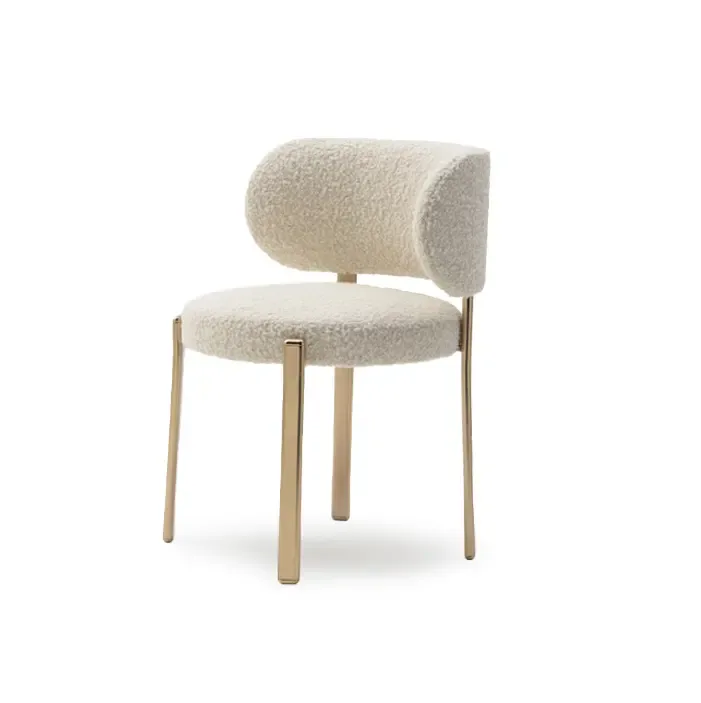
Stainless chair tube ends: welded caps, push-in plugs, vent hole pairs and the salt spray numbers that pick the right closure
An open tube end on a stainless chair looks harmless and is the single most common source of internal rust we see on warranty claims. Condensation, wash-down water and salt film all get in and nothing dries out inside a 22 mm bore. This is how we close tubes, where each closure type belongs and the tests a frame passes before it ships.
Published by JPChairs · Chair manufacturer in Foshan, China · 2026-11-09
What gets into an open tube
The 25 by 1.5 mm tube with a 22 mm bore and a 450 mm leg holds 0.17 litres of water when full, and it fills by condensation long before anyone splashes it. In a coastal dining room the interior humidity crosses the dew point nightly, so the inside wall of the tube cycles wet and dry every 24 hours. The weld seam on the inside of the tube never sees the acid bath, because pickling lines treat the outside surface, and the unwashed heat-affected zone is where the first bloom starts.
The visible symptom is a rust weep at the floor line: a brown ring on tile under the front leg, eight to twelve months after delivery. By the time it shows, the bore is lined with oxide from the weld root outward, and no external wipe-down fixes it. Cutting the frame open confirms the pattern every time, which is why we treat every open end as a defect, not a detail.
Three closure types and what each costs
We use three closures, chosen per tube family rather than per chair. A welded cap is a 1.5 mm 304 disc TIG welded on a 3 mm fillet all round; it is hermetic and costs 0.40 to 0.60 USD per frame including the repassivation dip, because the weld zone must go back through a citric acid passivation at 60 C for 10 minutes or it becomes the new weak point.
The push-in plug is a ribbed PE or POM insert with a 3 mm vent slot, 0.08 to 0.15 USD per frame, specified with a pull-off retention of at least 80 N so a child pulling on the leg end cannot remove it. A threaded 304 cap with an O-ring runs 0.90 to 1.30 USD and is reserved for frames we know will be drilled or modified later, where serviceability matters more than cost.
- Welded cap: hermetic, 0.40 to 0.60 USD, needs repassivation after welding
- Push-in plug: vented, 0.08 to 0.15 USD, 80 N minimum pull retention
- Threaded cap: serviceable, 0.90 to 1.30 USD, for frames drilled after delivery
The vent hole pair rule
The single drain hole in a capped tube does not work, and we learned this on a batch of terrace chairs in 2023. Water bridges across one 6 mm hole by surface tension, and the bore still holds 8 to 12 ml after rain. Two holes 10 mm apart break the bridge and the same bore drains in under 60 seconds.
Position matters as much as the pair. A standing chair leans back 3 to 5 degrees, so the true low point of a horizontal tube sits at the 4 or 8 o'clock position, not at 6. Holes drilled at 6 o'clock leave a standing residual in every frame that leans. On welded indoor caps we leave no holes at all; on welded outdoor frames the pair is drilled to 6 mm and deburred, with the burr removed from the inside wall because that edge is where corrosion nucleates.
Matching the closure to the position
Front legs and any pad-bearing end get welded caps, because those ends take floor moisture and the cap is the last line. Stretchers, seat rails and armrest ends get push-in plugs; they sit above the wash line and the vented plug keeps them dry without adding 0.50 USD per frame to the build.
Outdoor frames get welded caps plus the drain pair, never plugs alone. A PE plug survives UV for about three to four seasons before it embrittles, and once it cracks the bore is open again with nobody noticing. Indoor banqueting fleets are the exception that justifies plugs everywhere: the chairs are stacked, transported and handled hard, and a plug that gets knocked out costs 0.10 to replace, while a damaged welded cap means cutting the tube open.
QC numbers before a frame ships
Plugs are pull-tested at 80 N for 10 seconds on 10 percent of each lot; a lot fails below 80 percent passing and the mould batch is quarantined. Ingress is checked with a 5-minute spray at 2 litres per minute over capped frames, and the pass line is less than 5 ml of residual water inside the tube when we pull a cap and measure.
Welded caps go through ASTM B117 salt spray at 480 hours on sample frames, with no red rust allowed at the weld toe after the passivation dip. The fillet is gauged at 3 mm plus 0.5 minus 0.2, undercut beyond 0.1 mm sends the frame back to the welder. These are the same numbers we hold on the visible welds; a cap weld is not a hidden weld.
Specifying closures on an order
Ask for the closure type per tube family on the drawing, not a note that says sealed ends. A drawing that shows cap disc thickness, vent positions in clock terms and plug retention value can be quoted and checked by any welder in the shop. Which ends get which closure is a two-line table once the frame is broken into tube families, and it removes the one decision that gets left to whoever fits the frame that day.
The stainless steel chairs with sealed tube ends we list already carry the closure table in the model spec, so the buyer sees which ends are capped and which are plugged before quoting. For how we translate a sketch into that drawing set, the OEM end cap drawings section shows the turnaround: 3 to 5 working days from a marked-up photo to a drawing with clock positions and retention values on it.