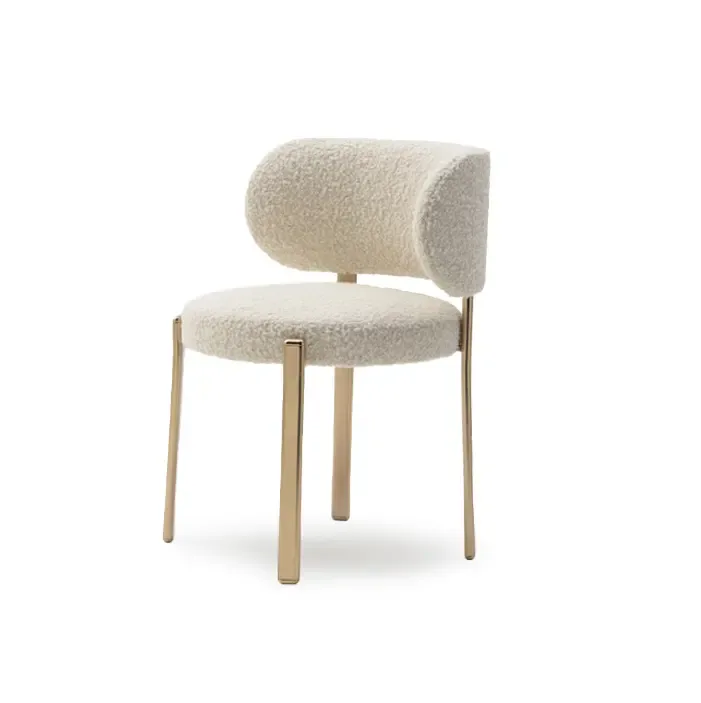
No.4 brushed stainless on chair frames: the roughness numbers, grain direction rules and how a scratched frame stays repairable
Brushed stainless frames are judged by eye, decided by a number and ruined by one careless repair. Two frames can leave the same tube with the same written specification and still look like different products three metres apart in a finished room, because No.4 is a process rather than a colour. This is how we specify it on chair frames, what we measure, and how a scratched frame gets saved.
Published by JPChairs · Chair manufacturer in Foshan, China · 2026-10-31
No.4, hairline and mirror: three different answers
Finishes get quoted as though they were interchangeable. They are not:
- 2B: the mill finish off the coil, smooth and slightly reflective, typically 120 to 160 gloss units measured at 60 degrees.
- No.4: a unidirectional polish finished at 150 to 180 grit, which covers almost all brushed stainless chair frames. Sixty to 110 gloss units, roughness Ra 0.2 to 0.4 µm.
- Hairline: the same idea taken finer at 240 to 320 grit, Ra 0.1 to 0.2 µm. Softer to look at, harder to repair invisibly.
- Mirror: above 500 gloss units. We do not use it on chairs, because every fingerprint and handling mark stays visible for the life of the frame.
Specify roughness, not a name. The words No.4 on their own permit anything from Ra 0.8 down to Ra 0.1, and two chairs at either end of that range do not look like the same product.
The grit sequence, and why skipping costs more than it saves
Brushing is a sequence, and the cost sits in the middle steps nobody sees:
- 80 or 120 grit to level: this takes off the weld bead and any handling score. Skip it and you simply polish a dent into a shiny dent.
- 150, then 180: each pass has to remove the scratches of the one before it, so we allow no more than one grit step between operations.
- 240 or 320 final: depending on whether the drawing calls for No.4 or hairline.
Hand work runs 2.5 to 3.5 minutes per frame at 0.15 to 0.25 MPa contact pressure. Abrasives are changed after 8 to 12 frames because a loaded flap disc stops cutting and starts burnishing, which dulls the finish frame after frame without anyone noticing. Welds are polished through with 80 grit and then blended 60 to 80 mm either side of the bead, so the joint stops casting a shadow under restaurant lighting.
Grain direction is the fault buyers notice first
Every visible member should carry its grain along its own long axis, and every part of a frame should read in the same language:
- Tolerance: grain angle within 5 degrees between adjacent members. Past 8 degrees the joint reads as two different materials at 1.5 m.
- Bends and formed corners: the grain stretches through a bend and roughness rises about 0.1 to 0.3 µm in the deformed zone, so blend the bend rather than leaving it to chance.
- Round versus square tube: square tube has a flat to follow and forgives less. On round tube the eye reads the crown line, so consistent pressure matters more than the exact angle.
- Never swirl: a random-orbital sander leaves cross grain that no amount of later polishing removes. Finishing runs one direction, along the tube, with the last strokes top to bottom.
We approve two reference panels per project and keep one on the floor, where it travels with the work instead of living in an office drawer.
Keeping it clean between the polish and the carton
- Protective film: 0.05 to 0.08 mm polythene at 200 to 400 g per 25 mm adhesion. Any stronger and it leaves residue, any weaker and it lifts in transit.
- Removal window: strip it within 30 days of application, and never after a frame has been through a container above 60 °C. Baked adhesive needs solvent, and solvent dulls the grain.
- Segregation: stainless tube and finished frames stay at least 3 m from carbon steel grinding, with their own non-ferrous wheels and belts.
- Storage: below 70 per cent RH and off the floor. Free iron dust landing on a finished frame rusts within 48 hours at 80 per cent RH, and it looks like a defect in the steel itself.
Film also decides when final inspection happens: once it comes off for assembly, handling marks are on the frame for good, so the last approval has to be before the packing bench.
Repairing a scratch without making it worse
Most site repairs turn a 40 mm scratch into a 200 mm shiny patch, because the repair runs across the grain instead of along it:
- Shallow marks: one non-woven pad matched to the final grit, 240 or 320, worked wet and single direction, 8 to 12 strokes parallel to the surrounding grain. Around ten minutes.
- Gouges deeper than 0.2 mm: step back to 120 grit locally, then climb through 180, 240 and 320. Fifteen to 25 minutes per location, and the repair will read slightly finer than the field for about two weeks.
- After polishing: the abraded area has no passive layer, so run a citric passivation paste for 10 minutes, rinse with clean water and dry. Without it the repair is where the rust starts.
- Never: circular motion, dry sanding above 120 grit, or steel wool, which presses free iron into the grain.
Anything larger than a palm-sized area belongs back with the maker, because blending to a panel edge is the only way to hide it.
What to specify and how to check it
- Roughness by number: Ra 0.4 µm maximum on visible members for No.4, measured at three points per frame rather than eyeballed, and Ra 0.1 to 0.2 µm for hairline.
- Two signed reference panels, one kept by you and one by the factory, replaced every 12 months.
- Inspection conditions: 1.5 m viewing distance, 500 lux, 10 seconds per frame, tilted three ways.
- Grain direction drawn onto the plan with one member named as master, plus the 5 degree tolerance between members.
Brushing adds about USD 4.50 to 7.50 per frame over 2B, which is why it is the first thing quietly dropped from a quotation; ask for the Ra line and it becomes visible again. Every finish we ship has been through our OEM finish approval process, and the frames held to these numbers are the ones in our brushed stainless steel restaurant chairs.