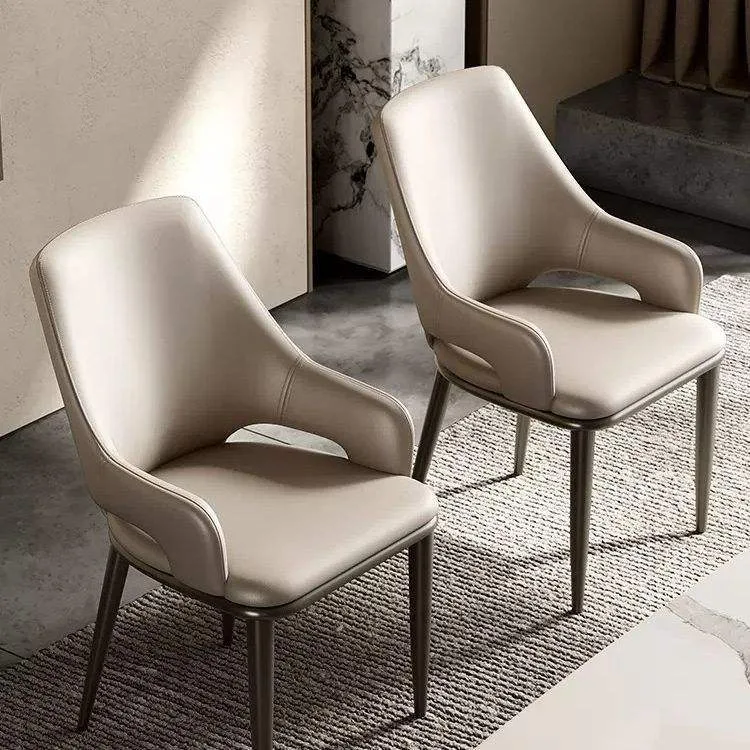
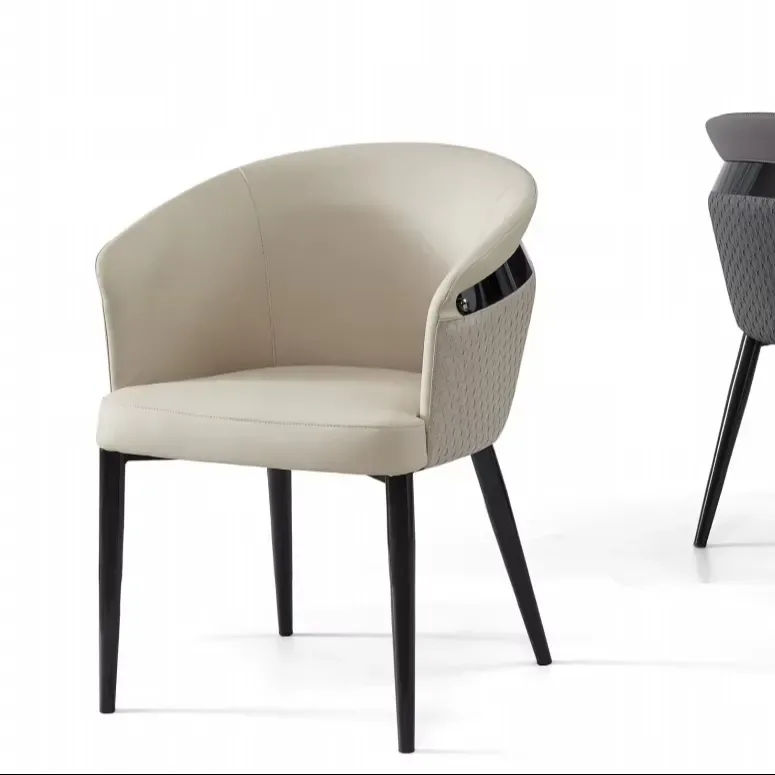
Weld grinding grades on iron chair frames
Every iron chair drawing eventually gets a note that says clean the welds. Nobody defines clean, so the grinder on the floor defines it, and the price moves by several dollars a chair between one order and the next. This is how we grade, sequence and price the work.
Published by JPChairs · Chair manufacturer in Foshan, China · 2026-11-14
The ground weld costs more than a good weld
An iron dining chair leaves our welding bay with 22 to 28 joints a buyer can see: four leg-to-seat connections, the seat frame corners, the back uprights and the cross rails. Each one has to be looked at before it can be coated, because powder does not hide a weld, it magnifies it.
- Grinding one joint takes 3 to 8 minutes with a 60 grit flap disc, a file and a hand brush, depending on how much metal the welder left behind.
- On 1.2 to 2.4 bench hours per chair, grinding is 40 to 60 percent of the total, which at 3.60 USD per hour is 4.30 to 8.60 USD inside the FOB price.
- That is 9 to 14 percent of a 60 to 95 USD iron chair, spent on a step most drawings describe in three words.
- Rejects come from the same place. A witness line under the coating, a dished seat rail or a burnished edge stays visible for the life of the chair and cannot be fixed after coating without stripping and re-blasting the frame.
So the useful question is not whether the welds are ground. It is to what standard, on which faces, and at what cost.
Grade the faces before you grade the weld
We ask every buyer to mark three face grades on the frame drawing. It takes ten minutes and it removes most of the argument at final inspection.
- Class-A faces are everything within 600 mm of a seated guest at eye level: the top and front of the seat frame, the back uprights and the top rail. Reinforcement 0 to 0.3 mm, no visible witness line, dishing no more than 0.2 mm, edge radius kept at 1.5 mm or more.
- B faces are the underside of the seat frame and the inside of the legs, seen when a chair is lifted or stacked. Reinforcement up to 0.8 mm is acceptable, dishing 0.5 mm, and grinding marks are allowed as long as they are not sharp.
- C faces are hidden joints inside the frame, under the seat pan and behind the back brackets. Left as welded, no grinding at all.
- Lighting is part of the grade: 500 to 750 lux at the bench plus a raking light at 15 degrees for A faces, because a joint that looks flat under ceiling light shows a 0.1 mm step under a raking light.
In practice 6 to 9 joints per chair land in A, 8 to 12 in B and the rest in C. Grading cuts grinding time by 25 to 35 percent against grinding every joint to one level.
Grit sequence and blend width
The grit sequence is what separates a ground weld from a sanded one. Jumping from 60 grit to 180 leaves scratches that read through a 60 to 80 micron powder film as a dull patch.
- 60 grit flap disc to take down reinforcement, 80 grit to flatten, 120 grit to erase the 80 grit pattern, and 180 grit only on A faces before coating.
- Blend 20 to 25 mm either side of the weld so the transition sits in a flat area instead of on a corner.
- Step height after blending no more than 0.05 mm on A faces and 0.2 mm on B faces, checked with a straight edge and feeler gauge.
- Do not cross the grain on a visible face. On 25 mm square tube the scratches run along the tube, never across it.
- Finish with a clean and strip disc rather than a wire brush, because a wire brush polishes the surface, and polishing is the next problem.
Wall loss and what it does to the frame
Every pass of a 60 grit disc removes metal from a 1.5 mm wall. Measured on scrap frames, a typical joint loses 0.05 to 0.15 mm, which is 3 to 10 percent of the section.
- We hold 1.30 mm minimum at the leg-to-seat joints, the highest stress points, and reject any frame below that on an ultrasonic gauge.
- Stiffness at a 90 degree corner follows the cube of the wall, so 1.30 mm is roughly 35 percent less stiff than 1.5 mm at that corner.
- Burnishing is the second risk. A face polished below about Ra 0.8 micron loses the mechanical key the conversion coating needs, and adhesion drops from Gt0 to Gt2 on an ISO 2409 cross cut.
- The fix is cheap: a 120 grit refresh over any polished area gives a 3 to 6 micron anchor profile before the phosphate stage.
Cutting minutes without losing the grade
Most grinding time is created upstream, in the weld itself. Three changes take 40 percent out of it on the same drawing.
- Control fillet size. A 4 to 5 mm leg fillet on 1.5 mm tube passes EN 16139 level 1; a 7 mm fillet takes twice as long to blend and adds nothing but heat.
- Pulse MIG at 180 to 220 A with 1.0 mm wire throws 20 to 30 percent less spatter than short circuit transfer, and spatter removal often costs more time than blending.
- Fixture the fit. A gap above 0.5 mm between tube ends forces the welder to bridge it, which leaves a lump that has to be ground from both sides.
- On a 24 joint frame this takes grinding from 1.8 to 1.1 hours, about 2.50 USD per chair, or 1,250 USD across 500 chairs.
The lines to put on the order
Five lines turn a verbal instruction into something a grinding bench can be held to.
- The face grade map, drawn on the frame drawing with A, B and C marked, plus two photographs of accepted joints and one of a rejected joint.
- Grit sequence and blend width, written as 60, 80, 120, 180 with a 25 mm blend.
- Reinforcement and dishing limits per grade, with the measuring method named.
- Minimum wall thickness after grinding, and the gauge used to check it.
- Inspection level: 100 percent visual on A faces at 500 lux, plus 1 in 20 frames checked with a 10x loupe at the weld toe for undercut and pinholes.
Written this way the note becomes a price line instead of a surprise, and the same grade survives from the sample to the third container. Our powder coated iron dining chairs ship with that grade map as standard, and the factory weld and grinding cells run the same sequence for every frame in the run.